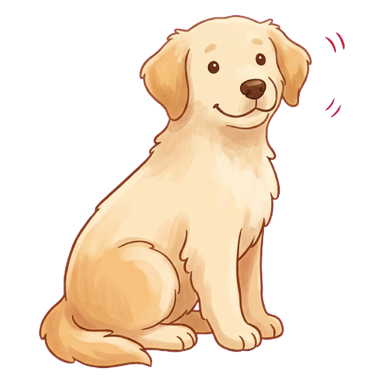
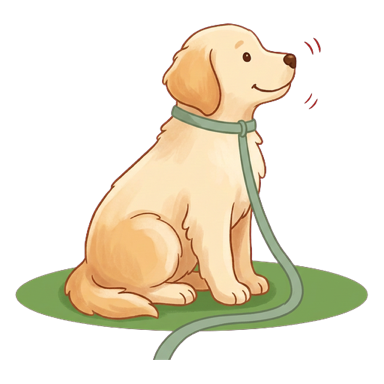
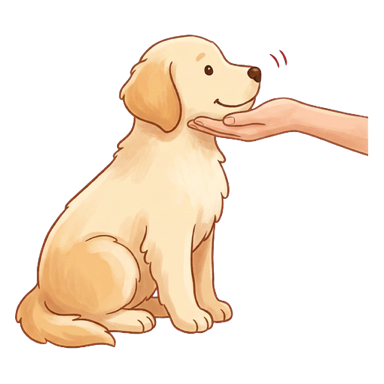
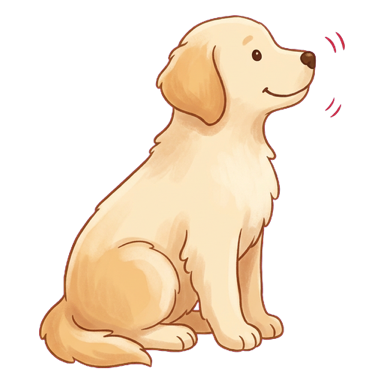
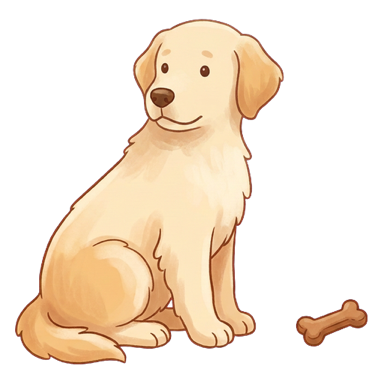
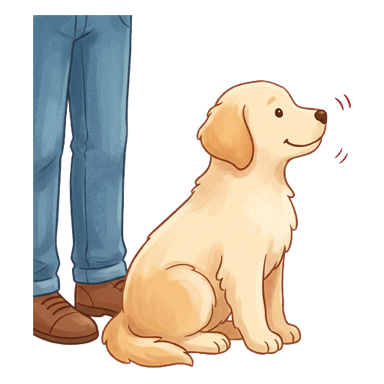
A video of a dog sitting does not teach your dog to sit. Tavi orders the skills around your dog — their breed, their age and the goals you pick — then walks each one a step at a time, in short illustrated sessions written for the reward your dog actually works for.
This is the one decision everything else follows from — and it is the one almost no other app makes.
Open any other training app and “Sit” is one thing: a video, maybe a checklist. But teaching a dog to sit in a quiet kitchen and teaching it to hold that sit for five seconds while someone walks past are not the same lesson. They need different words from you, a different thing to watch for, and a different moment to pay.
So in Tavi, “Sit” is not one lesson. It is four steps, and each step carries its own five-card script. If the script hung off the skill instead, you would be handed the same five cards for “Capture the sit” and “Sit with a distraction” — and the thing you were actually working on would never get practised.
Each step also names the single dimension it raises: duration, distance or distraction — the three D's. A duration step varies only how long. A distraction step drops the duration back down and varies only what is going on nearby. One criterion at a time, which is Karen Pryor's first law and the part beginners most often skip.
A card tells you the exact word to say, the exact thing to do, and the one criterion you are working on. You swipe right if it landed, left if it did not. That is the whole interface.
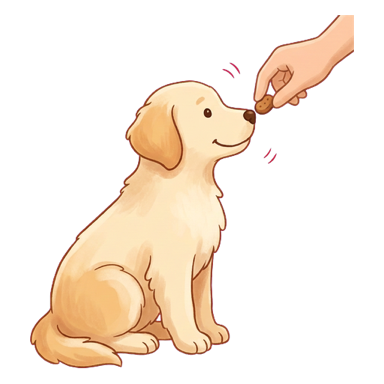
Say it once, then hand over a treat straight away.
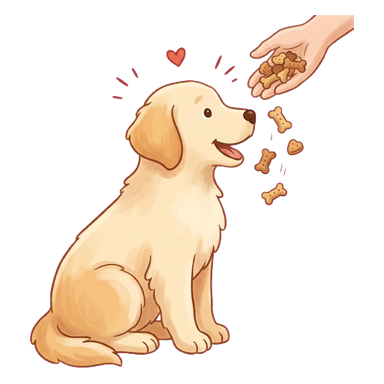
Easy last one, quiet room, nothing to get wrong — mark, then give a small handful of treats, one after the other.
Every single one of the 43 steps finishes on a deliberately simple rep that pays a jackpot — an outsized reward, not just a bigger treat. Pryor's point is that a session's ending is what the dog remembers and what decides whether it wants to play again tomorrow.
So the difficulty curve inside a session goes up, then drops at the end on purpose. Nobody finishes on a failure.
Tell Tavi you have fifteen minutes instead of five and you get three passes through the same five cards — not three separate sessions logged.
That distinction matters because progress is measured in sessions on separate occasions. If longer sittings created more sessions, one enthusiastic afternoon could tick off a week of learning your dog had not actually done.
Telling the owner of a toy-obsessed collie to “hand over a treat” is the fastest way to lose their trust in the coaching. So no instruction in Tavi is generic — the words are assembled for your dog at the moment the card is drawn.
Mark the instant {name} sits, then {reward} — and if {they} hold{s} it, {jackpot}.
Mark the instant Luna sits, then hand over a treat — and if she holds it, give a small handful of treats, one after the other.
Mark the instant Baxter sits, then throw the toy — and if he holds it, play a long game with the toy.
Mark the instant Pip sits, then give big praise — and if they hold it, make a big, noisy fuss.
For a food dog it is several treats in a row, because the repetition is what reads as a windfall. For a praise dog it is a full-on noisy fuss. Tavi keeps those distinct rather than bolting the word “big” onto whatever you picked.
When a step needs something tempting nearby to proof against, Tavi deliberately picks something that is not what your dog is being paid in. Asking a toy-driven dog to ignore a toy and then rewarding it with a toy is a lesson in nothing.
The first three are free forever — and they are the foundation, not a teaser. You cannot meaningfully teach anything else until the marker means something.


Two owners with the same breed get different plans if they want different things. Here is exactly what moves the order, because you should be able to check our working.
What you want most carries the heaviest weight. Pick recall as a goal and recall climbs the list past everything that is not a foundation.
What is going wrong right now counts too, slightly less. Tell Tavi your dog pulls and loose-lead walking moves up; tell it your dog jumps at visitors and polite greetings does.
Your dog's age overrides both for one skill. Under about eight months, house training jumps to the front regardless — and for a dog over two, it drops away, because you have almost certainly solved it.
Your dog's breed breaks ties. We mapped 343 breeds into training profiles using DK's The Complete Dog Breed Book, down to the page. A breed with scent, chase, roam or herding drive gets recall nudged earlier. A high-energy breed gets loose-lead walking earlier.
Charging the marker and teaching the name always come first. They are not scored, not reordered and not skippable — an experienced owner can move through them faster, but nobody gets to start at “Sit”.
Your order is worked out by a plain, deterministic rule on your own device. The AI coach is then allowed to do two things: put that order into a sentence or two of plain English, and — after a session that went badly — suggest the single smallest change worth making.
It cannot reorder your plan, invent a lesson, move the bar for what counts as mastered, or change a word of a rep script. Those limits are enforced on our server, not left to the model's good judgement.
Pick a goal that no skill in the library serves and Tavi lists it back to you as unserved rather than quietly dropping it and building a plan that looks complete.
Three problems are outside what any app should coach, and Tavi will not try. Tell it you are dealing with one of these and it stops — no module, no tips, no “try this first”. It points you to a certified behaviourist or your vet, which is the only responsible answer.
This is not a prompt we hope a model obeys. The refusal is a hard rule that runs on our server before any AI is called at all — so it holds even if the model misbehaves, the key is missing, or the request is worded to get around it.
And for the sake of being straight with you: barking, mouthing and chewing don't have a module yet either. Tavi says that rather than pointing you at “Leave it” and hoping it helps — play-biting is not the same problem, and pretending otherwise would be worse than saying nothing.
Not when you tap “done”. Not when you have watched the video.
One good run is a good day. Two consecutive good runs is learning. A weaker session resets that streak — but it never takes back a step you have already mastered, because losing a badge for having a bad Tuesday teaches the owner to stop logging honest misses.
A miss is information: it tells the app the step is too hard yet, and it is what lets the coach spot what to change. The only way to get this wrong is to mark every try a success when it wasn't.
Retake a mastered skill and the progress clears so you can work through it again — but the skill stays marked as mastered while you do. Dropping the badge mid-revision would read as a punishment for revising.
Every session, every illustration and all of your history live on the phone. Sessions log fine on a walk with no bars. The only thing that pauses offline is the optional AI tip, and the app tells you so instead of failing quietly.
The method in this module comes from a small body of controlled work and one very good book. These guides lay it out, named study by named study — including the places the evidence is thinner than anyone would like.
Three of the ten skills are free forever — Charge your marker, Name & attention and House training. That's the whole foundation plus the one thing a new puppy owner needs on day one, and it is 55 rep cards. The other seven skills come with Tavi Premium.
No. You choose how you mark: your own voice (“Yes!”), a clicker you already own, or the in-app clicker. Tavi adapts the instructions, the button and its wording to whichever you pick — if your marker is your voice, the app's button stays deliberately silent, because a second noise from the phone would just be a second, late marker.
No, and deliberately so. Your plan's order is computed by a deterministic rule on your device. The AI is allowed to explain that order and to suggest one small change after a session that went badly — it cannot reorder anything, change what counts as mastered, or write a lesson. Every rep script in the app was written by a person.
Aggression, resource guarding and severe separation distress — those go to a professional, and the app refuses rather than improvising. Barking, mouthing and chewing have no module yet; that's a gap we'd rather name than paper over. And training is dog-only for now: cat owners get an honest “not yet” instead of a dog curriculum with the species filed off.
Marker and reward training in the tradition of Karen Pryor's Don't Shoot the Dog! — one criterion at a time, end on a win, and back to kindergarten when a step falls apart. The breed tailoring comes from DK's The Complete Dog Breed Book (2019). Positive reinforcement only: no corrections, no aversives, no equipment beyond a lead and whatever your dog likes to be paid in.
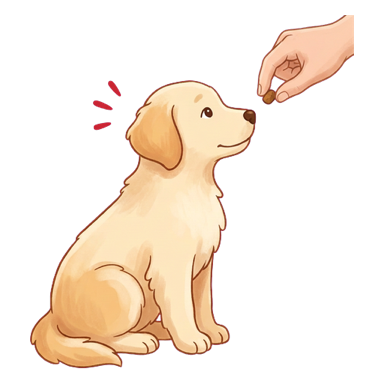
No — every rep is a still illustration, one per card, 215 of them. That's a deliberate trade: stills work offline, load instantly, and keep your eyes on your dog instead of on a screen. A handful of steps would genuinely be clearer as short loops (the lure into a down, a lead turn) and those are the ones we'd add motion to first.