What Is Positive Reinforcement Dog Training — and Does It Work?
Start here
Positive reinforcement training means adding something the dog wants immediately after a behaviour you want more of. It is a contingency, not a mood. In a controlled trial by China, Mills and Cooper (Frontiers in Veterinary Science, 2020), reward-trained dogs answered a recall on the first cue 82.5% of the time against 71.0% for dogs trained with electronic collars. It works, and it costs the dog less.
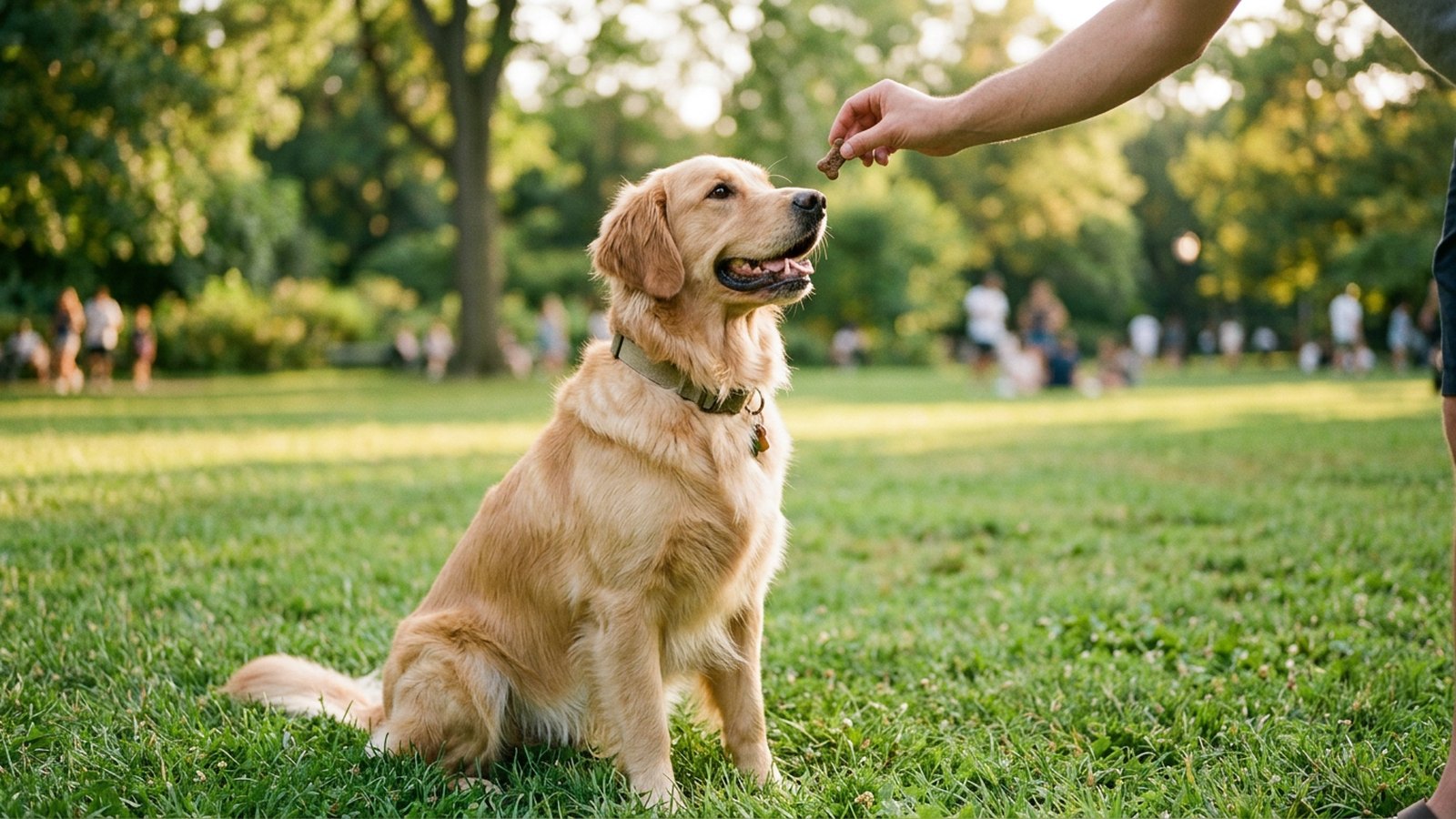
What positive reinforcement actually means
Positive reinforcement is a technical term, and the technical part is the part people skip. "Positive" does not mean kind; it means something is added. "Reinforcement" means the behaviour that just happened becomes more likely. Add something the dog values immediately after a behaviour, and that behaviour gets stronger.
The load-bearing word is contingency. A treat handed over because your dog is lovely is a gift. A treat delivered the instant the dog's back end touches the floor is reinforcement. The dog learns nothing from the first and something precise from the second, and the only difference is what the food depended on. For where this sits next to punishment, see the four quadrants of dog training.
Two things follow. Only the dog decides what counts as a reinforcer: for a spaniel with a tennis ball in view, cheese is an interruption. And if a behaviour is not getting stronger, it is not being reinforced, whatever you meant to do. That is a definition, not an opinion, and the fastest diagnostic you have when training stalls.
Practical take: Judge a reward by whether the behaviour increased across the week, not by whether the dog ate it. A dog will happily take a biscuit and still sit no faster than before.
Does it work? The head-to-head evidence
Most of what is written about reward-based training online is assertion. A smaller body of controlled work exists, and it is worth naming. The cleanest comparison is China, Mills & Cooper in Frontiers in Veterinary Science (7:508, 2020). Sixty-three dogs were split into three matched groups and trained by professionals, one set with reward-based methods, the others with electronic collars. On recall, the reward-trained dogs responded on the first cue 82.5% of the time against 71.0%, a statistically significant difference (p = 0.015). Asked to sit once back, they were quicker too: 1.36 seconds against 1.67.
Be honest about the size of that. An eleven-point gap is a real advantage, not a rout. What the trial establishes is narrower and more useful than "rewards are magic": on a standard obedience task, in professional hands, the reward-based method was measurably better, so the usual defence of aversive tools, that they deliver results nothing else can, did not survive the test. The reward-based recall guide has the protocol.
What the training does to the dog
Effectiveness is half the question; the other half is what the dog carries away. Vieira de Castro and colleagues (PLOS ONE 15(12), 2020) followed 92 companion dogs at training schools of three kinds: aversive, mixed and reward-based. Mean lip-licking counts were 55.9 in the aversive group against 4.1 in the reward-based group, an effect size of d = 3.9. Cortisol was elevated in the aversive group. Weeks later, in a cognitive-bias test, the aversive-group dogs read an ambiguous situation more pessimistically.
That last result is worth sitting with, because it is not about the session at all. It suggests the effect outlasts the lesson and shows up in how the dog reads a neutral situation later. The caveat: owners chose their own school, so the groups were not randomly assigned, and a cognitive-bias test is a laboratory proxy for mood. The finding is strong; it is not airtight. DK's Complete Dog Breed Book reaches the same conclusion in plainer words, calling harsh handling "simply not effective" and "likely to cause more problem behaviours, including aggression and anxiety".
Why owners keep using punishment anyway
If the evidence points one way, why is the other approach still everywhere? Two findings explain most of it. Hiby, Rooney & Bradshaw surveyed 364 owners for Animal Welfare (13, 2004). Sixty-six per cent used vocal punishment, 60% praise and 51% food rewards: punishment was the most common tool in the house. The same survey found that the more tasks an owner trained by punishment, the more problem behaviours they reported. That relationship is correlational: it cannot tell you whether punishment produced the problems or the problems provoked the punishment.
Cooper and colleagues (2014) found something more uncomfortable: owners using aversive methods reported higher confidence in those methods, which is what the mechanics predict. Punishment often stops a behaviour in the moment, and what stops instantly is also the person's frustration, so the human gets reinforced on the spot while the dog's learning, or lack of it, shows up quietly and later. We take that loop apart in why punishment-based training backfires.
Do not reach for a choke chain, prong or shock collar because the reward plan felt slow this week. A stalled plan is almost always a criteria problem, not a motivation problem: you asked for too much at once. DK's breed reference is blunt that choke chains for disobedience are not effective, and the trial above found no performance payoff to weigh against the welfare cost.
The three building blocks
Reward-based training is not one technique but three.
A marker. A click or short word meaning "that, right there, is what earned the food". Karen Pryor defines it as a conditioned reinforcer in Don't Shoot the Dog! (Bantam, 1985, p. 33). The evidence on whether it helps is genuinely mixed. Gilchrist and colleagues (PeerJ, 2021) ran two controlled studies in pet dogs on simple tasks and found a clicker gave no advantage over food alone or over a verbal marker. Lazarowski and colleagues (Frontiers in Veterinary Science, 2025) tested 28 detection dogs on a hard task with a long delay before the reward: those with a marker reached the final stage in 36 trials against 68 without, and alerted accurately 92% of the time against 69%. So a marker earns its keep when the behaviour is hard or the reward is delayed, and adds little for a sit in the kitchen. Mechanics in marker training.
Shaping. Reinforcing successive approximations until the finished behaviour appears. Pryor's ten laws (pp. 54–59) are the working manual. You will break Law 1 first: raise criteria in increments small enough that the dog always has a chance of earning something. Law 2 is the discipline most owners lack, training one aspect at a time. Law 4 says relax the old criteria when you add a new one. Law 9 saves sessions: if a behaviour falls apart, go back to kindergarten. The full set repays reading.
Variable reinforcement. Once a behaviour is reliable, paying for every repetition is the weakest thing you can do. Pryor's slot-machine argument (pp. 36–40) is that an intermittent, unpredictable payoff makes a habit stronger and harder to extinguish. Law 3 says the same in training order: put the current level on a variable schedule before raising criteria. Pryor also describes the jackpot (p. 31), a reward out of all proportion to the repetition that earned it. This is how you come off food without losing the behaviour: see variable reinforcement.
A first session you can run today
Pick sit: you can reinforce it a dozen times without the dog leaving the kitchen.
- Count out a dozen small pieces of something soft the dog swallows instantly, not biscuits it has to chew.
- Wait. Do not ask. Stand still with the food out of sight. Most dogs offer a sit once nothing else works.
- Mark the moment the rear touches down with one short word, "yes", then deliver the food.
- Step sideways so the dog stands up, then wait again. Repeat.
- Add the cue only once the sit is reliable. Say "sit" just before the dog does it anyway, then mark and pay.
- Stop while it is still going well.
That last instruction is Pryor's Law 10, end on a high note. Law 8 adds that interrupting a session for no reason is itself a punishment, so finish deliberately rather than drifting off mid-rep. Pryor notes (p. 65) that appetite for reinforcement drops after roughly a dozen reinforcements, with an upper bound around 80 a day. Several short sessions beat one long one.
Be careful what you believe about timing. There is no established dog-specific interval for how fast a marker must follow a behaviour, and Pryor gives none. Tavi's app works to a one-second target, and that is our own design choice, not a published finding. Tavi's training module orders sessions by breed, age and prior experience, and illustrates every repetition.
The honest limits
Three caveats, because a guide that only sells the method is not much use. The first is scope. The trials above tested obedience tasks: recall and sit. They do not show that reward-based training resolves severe aggression, and nobody should tell you they do. A dog who has bitten, or whose behaviour is escalating, needs a qualified behaviourist in person and a vet check to rule out pain. Our overview of what drives aggression in dogs is a starting point, not a treatment plan.
The second is study design. The survey work is correlational, the welfare study was not randomised, and the trials used professional trainers, not you on a wet Tuesday with a bag of cheese. The evidence leans clearly one way, but it is a lean, not a proof.
The third is that training is not the only variable. Patronek and colleagues (JAVMA 209, 1996) ran a case-control study of why dogs are relinquished to shelters and found frequent indoor accidents and never attending an obedience class among the risk factors. Those are associated with the outcome; they do not cause it. Still, it is one reason we treat house-training as a welfare question rather than a convenience. Pryor lists eight methods of ending an unwanted behaviour and rates only four kind or reliable; punishment is not among them. Her fifth method, training an incompatible behaviour, is the one most owners can use tomorrow: a dog on a mat is not a dog barking at the door.
Reward-based training ordered for your dog's breed, age and experience
Tavi's training module puts reward-based skills in order, choosing what your dog is ready for from their breed, their age and how much training you have done before. Every repetition is illustrated, so you can see the position before you ask for it, and sessions run a few minutes. Free for your first pet.
Frequently asked questions
Does positive reinforcement dog training actually work?
Yes, on the tasks that have been properly tested. In a controlled trial by China, Mills and Cooper published in Frontiers in Veterinary Science in 2020, 63 dogs were trained by professionals using either reward-based methods or electronic collars. The reward-trained dogs answered a recall cue on the first ask 82.5% of the time, compared with 71.0% for the e-collar groups, and they sat faster afterwards. The gap is real but moderate. What it does rule out is the common claim that aversive tools are needed for results rewards cannot deliver.
Will I have to carry treats forever?
No, but how you stop matters. Food pays for a behaviour while the dog is learning it; it is not a permanent bribe. Once the behaviour is reliable you move to an intermittent schedule, paying some repetitions and not others, unpredictably. Karen Pryor's argument in Don't Shoot the Dog! is that this makes the habit stronger and harder to lose than paying every time, the same reason slot machines hold people. Keep occasional oversized rewards for exceptional efforts, and keep paying properly for anything genuinely hard, such as a recall away from a squirrel.
Does positive reinforcement work for aggressive dogs?
The verified trials cannot tell you. The controlled studies comparing reward-based training with aversive methods tested obedience tasks such as recall and sit, not aggression, so anyone quoting those numbers at you about a dog who lunges or bites is stretching them well past what they measured. Aggression usually has a driver underneath it: fear, pain, resource guarding, frustration. A dog whose behaviour is escalating needs a vet check to rule out a physical cause and a qualified behaviourist who can watch the real thing in person. Do not run a do-it-yourself plan on a dog who has bitten.
Do I need a clicker to train with positive reinforcement?
Probably not for everyday obedience. Gilchrist and colleagues ran two controlled studies in pet dogs on simple tasks, published in PeerJ in 2021, and found a clicker gave no advantage over food alone or over a verbal marker. But Lazarowski and colleagues, in Frontiers in Veterinary Science in 2025, tested 28 detection dogs on a hard task with a long delay before the reward: dogs with a marker reached the final stage in 36 trials against 68 without one, and alerted accurately 92% of the time against 69%. Use a marker when the task is hard or the reward is delayed.
Why does punishment seem to work when I use it?
Because it often stops the behaviour in the moment, and that is the part you notice. The dog goes quiet, you feel relief, and your own behaviour gets reinforced on the spot. Cooper and colleagues found in 2014 that owners using aversive methods reported higher confidence in those methods, which fits that loop exactly. What the moment does not show you is the cost. Vieira de Castro and colleagues, in PLOS ONE in 2020, recorded far more stress signals in dogs at aversive training schools, elevated cortisol, and a more pessimistic reading of ambiguous situations weeks later.
Tavi's guides are informational and not a substitute for professional veterinary advice, diagnosis or treatment. When in doubt, call your veterinarian.
Sources
- China, Mills & Cooper, Frontiers in Veterinary Science 7:508 (2020)
- Vieira de Castro et al., PLOS ONE 15(12) (2020)
- Hiby, Rooney & Bradshaw, Animal Welfare 13 (2004)
- Cooper et al. (2014)
- Gilchrist et al., PeerJ (2021)
- Lazarowski et al., Frontiers in Veterinary Science (2025)
- Patronek et al., JAVMA 209 (1996)
- Karen Pryor, Don't Shoot the Dog! (Bantam, 1985)
- DK, The Complete Dog Breed Book, 2nd edn (2020)