Variable Reinforcement: Why Rewarding Randomly Works Better
Start here
Variable reinforcement means rewarding some repetitions and not others, on no pattern your dog can predict. Karen Pryor's argument is the slot machine: an uncertain payoff produces a more persistent habit than a guaranteed one. Teach a new behaviour with a reward every time, then thin the schedule once it is reliable. The same law explains why lead pulling is so stubborn.
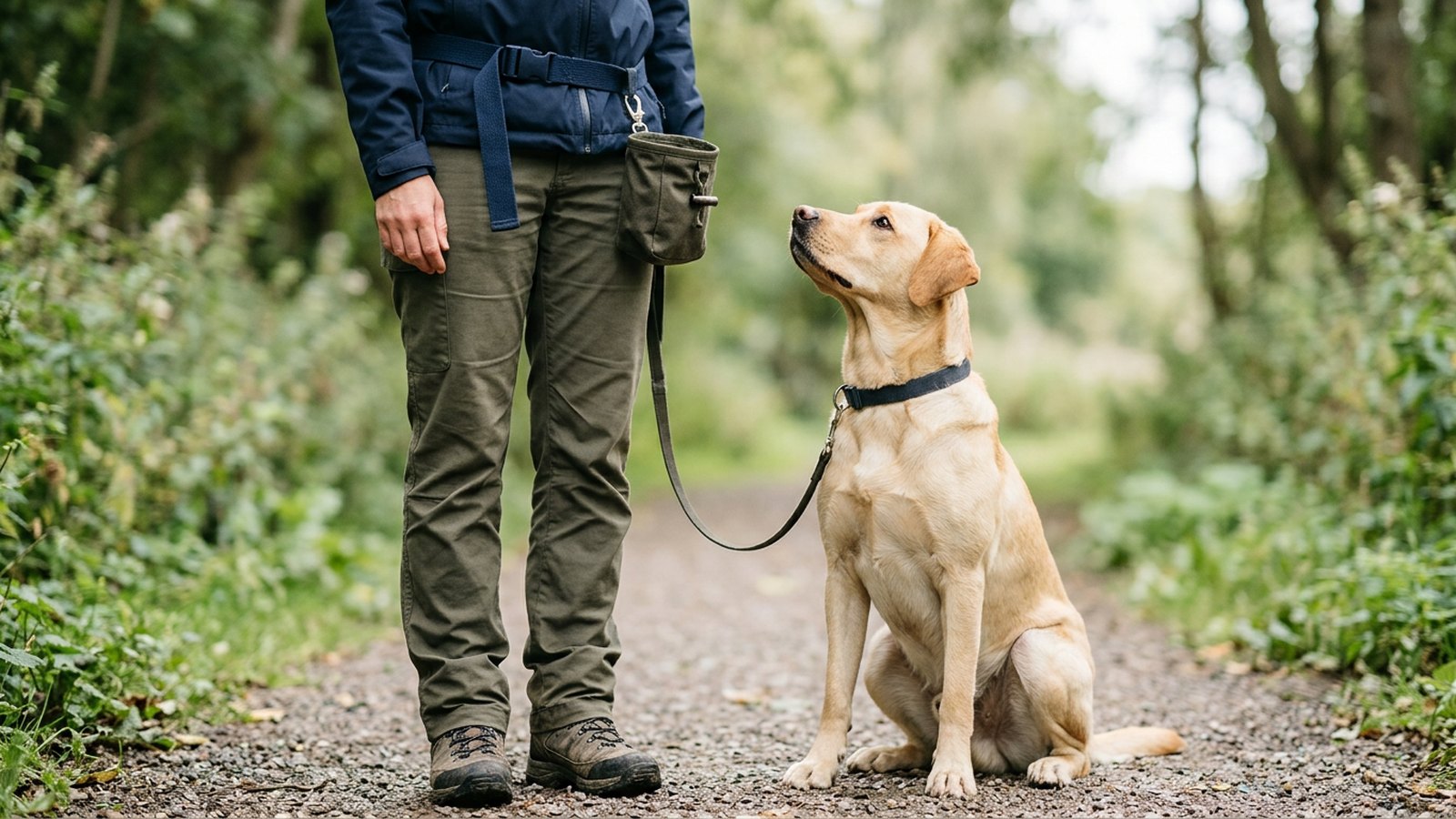
The slot-machine argument
Karen Pryor spends pp. 36–40 of Don't Shoot the Dog! (Bantam, 1985) on a single comparison, and it is the most useful passage in the book. A vending machine pays every time. When it stops paying you stop putting money in almost at once, because one failure is unambiguous information: the machine is broken. A slot machine pays sometimes, on no schedule you can work out, and people feed it for hours.
The behaviour built on the unreliable payoff is the one that persists. That is the whole argument, and it transfers straight to a dog. If your dog has been paid for every single sit, the first unpaid sit carries real information. If your dog has been sitting for weeks with treats arriving only now and then, in no pattern, an unpaid sit means nothing at all. There is no signal in the absence of a treat, so the behaviour keeps running.
Pryor's phrasing is that intermittent, unpredictable reinforcement makes a habit stronger and harder to extinguish. Both halves matter. Stronger is the part trainers like. Harder to extinguish is the part that comes back to bite you, and we get to that below.
What an unpredictable payoff does to effort
Two things change when the payoff becomes uncertain. The first is persistence. The second is that the dog stops treating the food as the thing being worked for and starts treating the behaviour itself as worth offering. Pryor's claim is that effort goes up, because a sloppy repetition might be the one that goes unpaid and the dog cannot tell in advance which one that is.
That has a practical edge. A dog on a continuous schedule learns “sit, get food”. A dog on a variable schedule learns “sit, and see”. The second version survives a walk where you left the treat pouch at home, a vet's waiting room, a friend's kitchen. It is also what people mean, loosely, when they say their dog works for praise now. The food did not disappear. It just stopped arriving on every repetition.
None of this is a reason to start thin. It is a reason to know where you are heading. The reward is still doing the work, and what positive reinforcement training actually involves is the mechanism underneath all of this.
Practical take: Thin the schedule by making the reward unpredictable, not by making it smaller. A treat that arrives every time but gets steadily more boring teaches your dog that the deal is getting worse.
Continuous while learning, variable once it is reliable
The rule is simple and most people get the order wrong. While your dog is learning a behaviour, reinforce every correct repetition. Continuous reinforcement is how a behaviour gets built: the dog needs clear, repeated information about which thing worked. Thinning the schedule at this stage does not make the dog try harder. It makes the picture noisy.
Once the behaviour is reliable at its current level, move it onto a variable schedule. Pryor's third law of shaping says exactly that: put the current level of behaviour on a variable schedule of reinforcement before raising your criteria. It sits next to her first law, raise criteria in increments small enough that the dog always has a chance of being reinforced, and her fourth, relax the old criteria when you introduce a new one. The full set of shaping laws is worth reading in order, because they only make sense together.
So the sequence for any one skill is: every repetition while it is new, variable once it is solid, then raise the difficulty and go back to every repetition at the new level. Variable reinforcement is not a destination you arrive at once and stay in. You pass through it at every step of every behaviour, and you leave it again the moment you make things harder.
The uncomfortable corollary: what you pay for by accident
Here is the part nobody enjoys. The law does not care whether you meant to use it. Anything that pays off sometimes, on no pattern the dog can predict, is running on a variable schedule, and that includes every behaviour you are trying to get rid of.
Take the lead. Your dog surges towards a lamppost. Most of the time you stop, or turn, or stand still and wait. Now and then you are late, or tired, or on the phone, and you take the step. That step is an unpredictable payoff for pulling, and it is doing precisely what Pryor describes: building a stubborn habit that survives long runs of nothing. It is why loose-lead walking is so much harder to repair than to teach from scratch.
The door is the same story. Your dog barks at a delivery. You ignore it, ignore it, ignore it, and then get up to look. Door barking is one of the hardest household behaviours to extinguish for exactly this reason, and the inconsistency is almost always the owner's rather than the dog's. If a behaviour you have been ignoring seems to be getting worse rather than better, that is usually the diagnosis.
Do not give in only when it gets really bad. That is the strongest variable schedule you can build. It teaches your dog that persistence pays eventually, which makes the next episode longer and louder than the last. If you are going to stop reinforcing something, stop completely, and give your dog an incompatible behaviour to do instead. That is Pryor's fifth method of ending an unwanted behaviour, and it is among the ones she considers kind and reliable. Punishment is not.
Jackpots are the top end of a variable schedule
A jackpot, in Pryor's definition on p. 31, is an occasional reward out of all proportion to the usual one. It can only exist because the schedule is variable. On a continuous schedule every repetition pays the same, so there is no baseline for a windfall to stand out against. Thin the schedule and you create the room for one.
Used well, a jackpot marks the repetition you most want repeated: a first success somewhere difficult, a recall away from something genuinely interesting, a breakthrough after a plateau. Used routinely it stops being a surprise, and a predictable jackpot is just a larger treat on a continuous schedule. Our guide to jackpot rewards goes through when a repetition has actually earned one.
The honest caveat: the jackpot comes from Pryor's practice, not from a controlled trial in dogs. It is plausible, it costs nothing to test, and there is no reason to think it does harm. That is a weaker footing than the recall research further down this page, and it is worth holding more loosely than a trainer selling it to you will.
How to start thinning the schedule this week
Pick one behaviour your dog already does well at home. A sit that comes on the first cue, without hesitation, in a quiet room is the usual candidate.
- Check that it is genuinely reliable. If your dog pauses, drifts, or needs the cue twice, it is not ready. Stay on every repetition until it is.
- Start skipping the occasional treat, chosen at random. Not every second repetition, and not the last one in a row. A pattern your dog can read is only a slower continuous schedule.
- Keep the marker on every repetition. The word or click still tells your dog the repetition was correct. What has become uncertain is whether food follows.
- Thin further only while quality holds. If repetitions get slower or sloppier, you moved too fast. Go back to paying every one and rebuild.
- Return to every repetition whenever anything changes. New room, new distraction, new criterion. That is Pryor's fourth law in practice, relaxing the old demands while a new one is being learned.
Two limits worth knowing. Pryor puts the point where appetite for reinforcement starts dropping at around a dozen reinforcements, with an upper bound near eighty in a day, so a thinner schedule is also how you get more repetitions out of the same hungry dog. And keep sessions short. Tavi's training module orders skills by breed, age and your own experience, which matters here mostly because it tells you whether a behaviour is really consolidated before you start thinning it.
Where the evidence is thin
Be clear about what is established and what is not. The schedule research Pryor draws on comes from operant laboratories and from marine-mammal training. We could not find a controlled trial comparing a continuous schedule against a variable one in companion dogs on ordinary household behaviours. The principle is old, well replicated in other species, and consistent with what experienced trainers report. That is not the same as a dog-specific result, and anyone telling you it is has skipped a step.
What is established in dogs is narrower and worth naming precisely. China, Mills and Cooper (Frontiers in Veterinary Science 7:508, 2020) ran a controlled trial with 63 dogs and found reward-based training beat electronic-collar training on recall to the first cue, 82.5% against 71.0%, with a faster sit afterwards, 1.36 seconds against 1.67. That supports rewards. It says nothing about how those rewards were scheduled.
Markers show the same mixed picture, and it is instructive. Gilchrist and colleagues (PeerJ, 2021) found a clicker gave no advantage over food alone or over a verbal marker in pet dogs on simple tasks. Lazarowski and colleagues (Frontiers in Veterinary Science, 2025) found a large effect in 28 detection dogs on a hard task with a long delay before the reward: 36 trials to reach the final stage with a marker against 68 without, and 92% alert accuracy against 69%. Difficulty appears to decide whether the technique matters at all. Variable reinforcement may well behave the same way, and if your dog is learning a simple thing in a quiet kitchen, the schedule is probably not the variable that decides the outcome. A behaviour falling apart usually has a duller explanation.
Know when a behaviour is solid enough to thin rewards
Tavi's training module orders skills by your dog's breed, age and how much training you have done before, so you can tell whether a behaviour is really consolidated before you start thinning the rewards. Every repetition is illustrated, and sessions run a few minutes. Free for your first pet.
Frequently asked questions
What is variable reinforcement in dog training?
Variable reinforcement means rewarding some correct repetitions and not others, on no pattern the dog can predict. Karen Pryor's argument in Don't Shoot the Dog! is the slot machine: a payoff that arrives sometimes, unpredictably, produces a more persistent habit than one that arrives every time. When the reward is guaranteed, a single unrewarded repetition tells the dog the deal has ended. When it is unpredictable, an unrewarded repetition carries no information, so the behaviour keeps running through long stretches of nothing.
When should I stop giving my dog a treat every time?
Once the behaviour is genuinely reliable at its current difficulty, and not before. While a dog is still learning, every correct repetition should pay, because the dog needs clear repeated information about what worked. Pryor's third law of shaping puts it directly: move the current level onto a variable schedule before you raise your criteria. And each time you do raise them, by adding distraction, distance or a new location, go back to rewarding every repetition until the behaviour is solid again at that new level.
Does variable reinforcement mean I can stop using treats?
No. Variable means unpredictable, not absent. The food still arrives, just not on every repetition, and the point is that the dog cannot tell which one will pay. Owners who read this as permission to phase treats out entirely usually watch the behaviour fade over a few weeks. If you want to reduce what you carry, make the rewards unpredictable rather than smaller or rarer in a pattern the dog can read. A shrinking, predictable reward simply teaches your dog the deal is getting worse.
Why does ignoring my dog's barking seem to make it worse?
Usually because the ignoring is not consistent. If you hold out most times and give in occasionally, when it gets loud enough or goes on long enough, you have built the strongest kind of variable schedule: persistence pays, eventually. The predictable result is longer and louder episodes. The fix is to stop reinforcing it completely and to train an incompatible behaviour the dog can do instead, which is one of the methods Pryor rates as both kind and reliable. Sudden new barking is also worth a vet check.
Is variable reinforcement actually proven to work in dogs?
Not directly, and it is worth saying so. The schedule research comes from operant laboratories and animal training practice rather than from controlled trials in pet dogs, and we could not find a trial comparing continuous against variable schedules in companion dogs on everyday behaviours. What is well established in dogs is that reward-based methods work: China, Mills and Cooper (Frontiers in Veterinary Science, 2020) found better recall from reward-based training than from electronic collars. How those rewards were scheduled was not what that trial tested.
Tavi's guides are informational and not a substitute for professional veterinary advice, diagnosis or treatment. When in doubt, call your veterinarian.
Sources
- Karen Pryor, Don't Shoot the Dog! (Bantam, 1985)
- China, Mills & Cooper, Frontiers in Veterinary Science 7:508 (2020)
- Gilchrist et al., PeerJ (2021)
- Lazarowski et al., Frontiers in Veterinary Science (2025)