What Is a Jackpot Reward in Dog Training?
Start here
A jackpot is one reward that is far bigger than the dog expects, given rarely, for something genuinely exceptional. Karen Pryor defines it as an occasional, out-of-proportion reward. Save it for a real breakthrough, a first success somewhere hard, or a recall away from something fascinating. Give one most sessions and it stops being a surprise, which is the only thing that made it work.
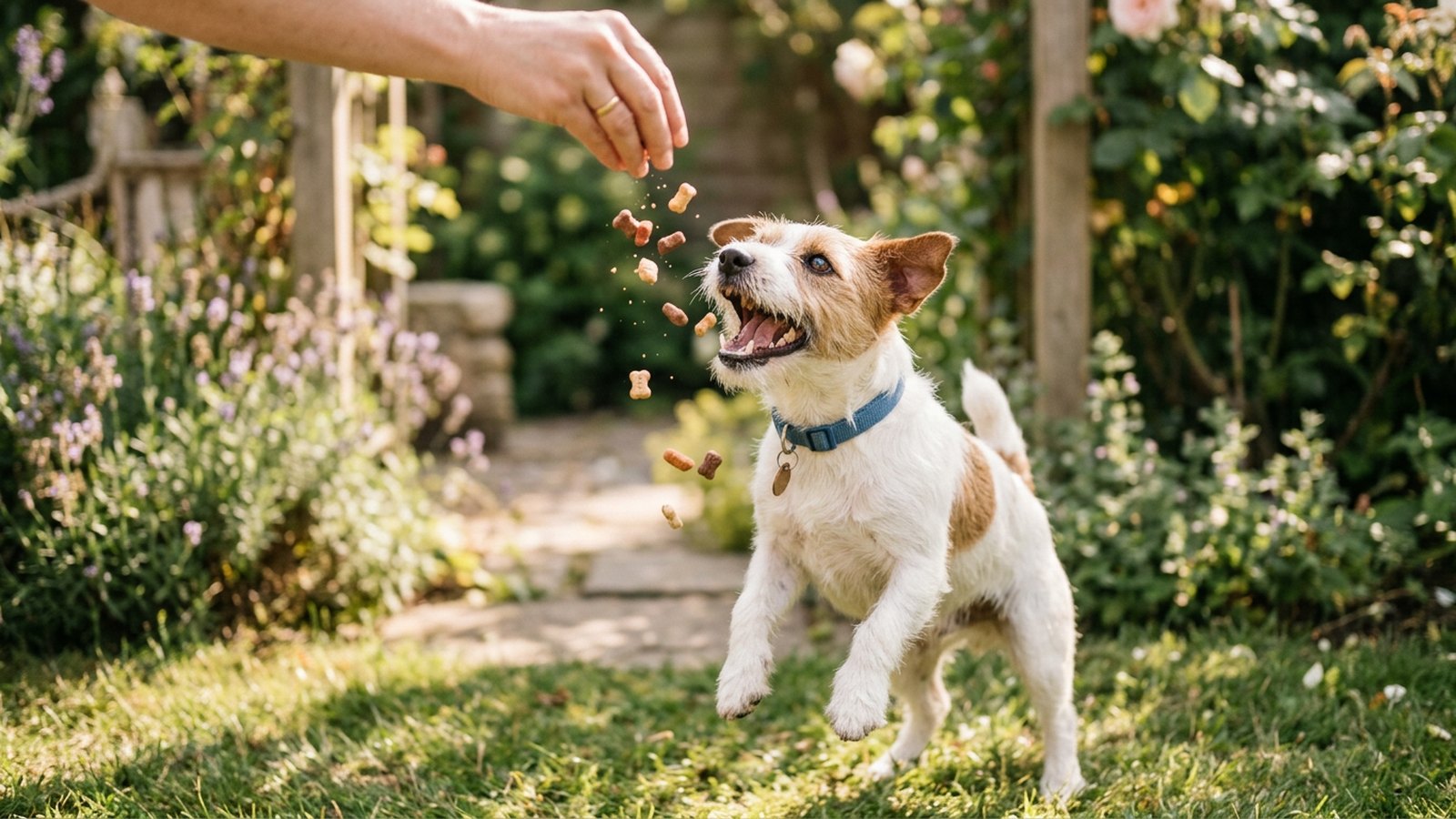
What a jackpot reward actually is
A jackpot is a single reward that is far larger than the one your dog has learned to expect. If a correct response normally earns one pea-sized piece of chicken, a jackpot might be ten pieces fed one at a time over fifteen seconds, or a whole strip of something the dog almost never gets. The term comes from Karen Pryor's Don't Shoot the Dog! (Bantam, 1985), where on p. 31 she defines the jackpot simply as an occasional, out-of-proportion reward.
Two words in that definition carry all the weight. Occasional means it cannot be the normal rate of pay. Out of proportion means the dog has to notice the gap between this payout and every other one. A jackpot is not a nicer treat; it is a break in an established pattern. The dog knows what this behaviour usually earns, and this once, it earned something else entirely.
That makes the jackpot a single technique living inside a schedule rather than a schedule of its own. The schedule is variable reinforcement, where the size and timing of the payoff are unpredictable. The jackpot is the rare top end of that unpredictability, and it only exists because the dog has a settled expectation for it to violate.
Why a surprise windfall is supposed to work
The logic behind jackpots is the logic behind unpredictable payoffs in general. Pryor's argument in Don't Shoot the Dog! (pp. 36 to 40) is the slot-machine one: a reward that arrives intermittently and unpredictably makes a habit stronger, and much harder to extinguish, than a reward that arrives every single time. A dog who does not know whether this repetition is the big one keeps offering repetitions.
A jackpot adds a second thing on top of that. Because it is so far outside the normal range, it is memorable. Trainers use it to mark the moment a dog got something right in a way they want that dog to remember tomorrow, not just to top up the reward account.
Here is where we should be straight with you. We could not find a controlled trial that isolates jackpots as a variable in pet dogs. The evidence base for reward-based training as a method is solid. China, Mills and Cooper (Frontiers in Veterinary Science 7:508, 2020) ran 63 dogs in three matched groups and found recall on the first cue at 82.5 percent for reward-based trainers against 71.0 percent for trainers using electronic collars, with the reward-trained dogs also sitting faster afterwards, 1.36 seconds against 1.67. But that trial compared methods, not reward sizes. The jackpot is a craft observation from professional animal trainers, and it is a plausible one, not a tested one.
Practical take: Use a jackpot as a well-founded trainer's trick. Don't build a training plan that depends on it, and don't expect it to rescue a behaviour with a thin reward history behind it.
The three moments worth spending one on
Because the effect comes from rarity, the decision is really about which moments deserve it. Three earn it reliably.
- A genuine breakthrough. The dog offers the whole behaviour for the first time, unprompted, without the half-second of hesitation you have been watching for weeks. That is the repetition you want burned in.
- The first success in a hard new place. A sit on the kitchen floor is not the same behaviour as a sit outside a busy cafe. The first time it holds in the harder place, pay like it mattered, because it did.
- A recall away from something genuinely interesting. If your dog turns away from another dog, a squirrel or a bin bag and comes to you, that choice cost them something. Pay accordingly. Our guide to training a reliable recall goes into how to build up to that in stages.
There is a fourth, quieter use. Pryor's tenth law of shaping is to end each session on a high note, and a jackpot is a clean way to do it: take a good repetition, pay it enormously, stop. Just make sure you are ending on a good repetition rather than manufacturing one.
When not to give one
The jackpot is most tempting exactly when it is least useful. After five minutes of your dog ignoring you at the park, they finally come back, and relief makes you empty the pouch. What you have paid for is the last thing that happened, not the five minutes of context you were upset about, and if the recall itself was slow and reluctant, that is the version of it you just made memorable.
Skip it, too, when the session has simply gone badly. A big payout does not repair a session where criteria were too hard; it teaches the dog that mediocre work sometimes pays enormously, which is the opposite of the signal you want. Pryor's ninth law is blunter and better here: if a behaviour falls apart, go back to kindergarten and rebuild it at an easier level.
Never show the jackpot in advance. A handful of food held out before the cue is a bribe, not a reward, and dogs learn very quickly to work only when the food is visible. A jackpot has to arrive after the behaviour, as a surprise. If your dog will not respond unless they can see the food first, that is a separate problem to fix, and no amount of jackpotting will fix it.
Jackpot versus simply using better treats
People often collapse these two into one idea, and they are not the same decision. Treat value is a baseline choice you make before the session: chicken for the park, kibble for the kitchen, because harder environments need better pay. A jackpot is a deviation from whatever baseline you set. You can jackpot with a handful of the ordinary treats and it still works, because the dog is reading quantity and duration, not just flavour.
The two do interact. If you find yourself needing a jackpot just to hold your dog's attention in a moderately distracting place, the honest read is usually that your baseline pay is too low for that environment, or your criteria are too high for it. That is a job for better everyday treats and an easier version of the exercise, not for a bigger occasional one. The same applies on the lead: if your dog only checks in for a windfall, look again at the fundamentals of loose-leash walking rather than escalating the payout.
Worth remembering, too, that a jackpot is not free. Pryor notes on p. 65 that appetite for reinforcement falls off after roughly a dozen reinforcements, and puts the upper bound at somewhere around 80 in a day. Ten pieces fed one at a time can read as ten reinforcements. Spend a couple of those and you have spent a chunk of the session's working capacity.
The commonest mistake: jackpotting until it stops being a surprise
This is the failure mode we see most, and it is a sincere one. The jackpot works, the dog lights up, so the handler uses it again the next day, and the day after. Within two weeks the big payout has become the expected payout. The dog now has a new baseline, and the old normal reward reads as a disappointment. You have not raised your dog's motivation; you have moved the reference point and lost your best tool.
It is worse than neutral, because a reward that drops below expectation can dampen the very behaviour you were paying for. The dog performed, the payout came in small, and the next repetition comes back a little flatter.
There is no verified number for how often is too often, and anyone who gives you one is guessing. A workable rule of thumb from practice: if you can remember every jackpot you gave this month without effort, the frequency is about right. If you cannot, it has become the wage rather than the bonus.
Practical take: Decide before the session that you have one jackpot available, and that you may well go home without spending it. Don't decide mid-session that this repetition feels special enough.
How jackpots fit into weaning off constant treats
Most people come to jackpots while trying to solve a different problem: the dog works beautifully with food and vaguely without it. The route out is not to cut rewards suddenly. It is to make them unpredictable first, which is exactly the point of the slot-machine argument, and to keep the occasional huge payout in the mix so the unpredictability stays worth betting on.
In practice that means three overlapping stages. Reward every correct repetition while the behaviour is new. Then shift to rewarding some repetitions and not others, at no pattern the dog can read. Then let food thin out further while praise, play and access to what the dog actually wants carry more of the load, with a rare jackpot still on the table for genuinely outstanding work. Pryor's third law of shaping is useful scaffolding here: put the current level on a variable schedule before you raise your criteria, not after.
Order matters more than most people expect, and it changes with the individual dog. A confident two-year-old can move through those stages faster than an adolescent who has just discovered the world is interesting. Tavi's training module sequences the skills and the thinning-out for the dog in front of you, which saves a lot of guessing about whether you have moved too fast. The broader framework these techniques sit in is covered in our guide to positive reinforcement training.
One last thing. If a dog who was working well suddenly stops responding to rewards they used to love, and food in general seems less interesting, that is worth a vet check rather than a training adjustment. Appetite changes are information.
Know when your dog has earned the big payoff
Tavi's training module orders skills by your dog's breed, age and how much training you have done before, so you can see whether a repetition is a real breakthrough or just a good day. Every repetition is illustrated, and sessions run a few minutes. Free for your first pet.
Frequently asked questions
What is a jackpot in dog training?
A jackpot is a single reward that is far bigger than the one your dog normally gets for that behaviour, given rarely and only for exceptional work. Karen Pryor, in Don't Shoot the Dog!, defines it as an occasional, out-of-proportion reward. In practice it might be ten small treats fed one after another instead of the usual one, or something the dog almost never gets. The effect depends entirely on the dog not expecting it, so a jackpot given regularly stops being a jackpot and simply becomes the new normal rate of pay.
How often should I give my dog a jackpot?
Rarely enough that you can still remember the last one. There is no verified number here, and any specific frequency you see quoted is someone's rule of thumb rather than a tested finding. What matters is the contrast with your dog's normal reward, so the honest test is whether the jackpot still surprises them. If your dog has started expecting a big payout, you have raised their baseline and lost the tool. A practical approach is to decide before each session that you have one available, and to accept that most sessions will not use it.
Does a jackpot reward actually work, or is it a myth?
The mechanism is plausible and widely used by professional trainers, but we could not find a controlled trial that tests jackpots specifically in pet dogs, so treat it as craft knowledge rather than proven science. What is well supported is reward-based training generally. China, Mills and Cooper, in Frontiers in Veterinary Science in 2020, found reward-trained dogs recalled on the first cue 82.5 percent of the time against 71.0 percent for dogs trained with electronic collars. That study compared methods, not reward sizes. Use jackpots as a sensible technique, not as a guaranteed shortcut.
What is the difference between a jackpot and just using higher-value treats?
Treat value is the baseline you set before a session, based on how distracting the environment is. A jackpot is a one-off deviation from whatever that baseline happens to be, and it works through quantity, duration and surprise as much as through flavour. You can jackpot with ordinary treats. If you find you need a jackpot just to keep your dog engaged in a mildly distracting place, the real issue is usually that your everyday reward is too low value for that setting, or the exercise is too hard there.
Can a jackpot help my dog come back when called?
It can, and recall is one of the best places to spend one. When a dog turns away from another dog, a squirrel or something fascinating on the ground and comes to you instead, they have given up something real, and a large surprise payout makes that choice memorable. Give it after they reach you, never held out in advance as a lure. If recall is unreliable across the board, though, a jackpot will not fix it. Build the behaviour in easier settings first and add distraction gradually.
Tavi's guides are informational and not a substitute for professional veterinary advice, diagnosis or treatment. When in doubt, call your veterinarian.
Sources
- China, Mills & Cooper, Frontiers in Veterinary Science 7:508 (2020)
- Karen Pryor, Don't Shoot the Dog! (Bantam, 1985)