The Laws of Shaping: How to Teach a Dog Any Behaviour, Step by Step
Start here
Shaping means reinforcing successive approximations: you pay the nearest thing the dog already does, then something closer, until you have the behaviour. Karen Pryor's ten laws of shaping, in Don't Shoot the Dog! (Bantam, 1985), govern it. Keep each step small enough that the dog can win, change one criterion at a time, relax the rest when you add a new one, and stop while it is going well.
What shaping actually means
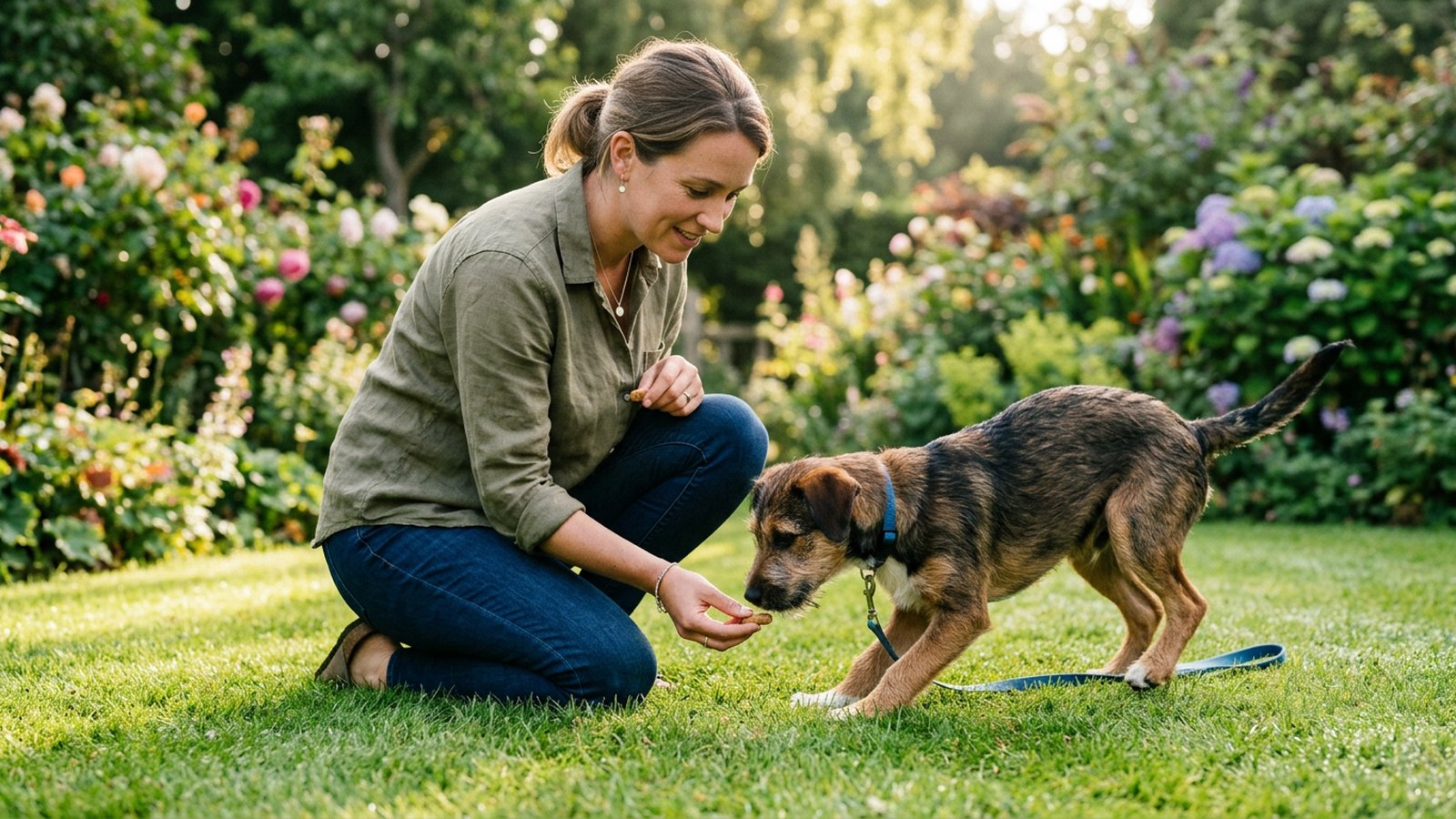
Shaping means reinforcing successive approximations. Instead of waiting for the finished behaviour so you can reward it, you pay the nearest thing the dog already offers, then something closer, then closer again, until the behaviour you had in mind is what the dog does by default. Nothing is corrected. You are only ever choosing what to pay for next.
The clearest account of the method is still Karen Pryor's Don't Shoot the Dog! (Bantam, 1985), which sets out ten laws of shaping across pages 54 to 59, worked out on dolphins as much as dogs. This guide covers seven of the ten, in Pryor's own numbering, leaving the gaps where they fall, because we only state what we have checked against the book.
Shaping sits inside reward-based training, and that groundwork is worth having first: see what positive reinforcement actually is. The evidence there is decent on ordinary obedience tasks: in a controlled trial by China, Mills and Cooper (Frontiers in Veterinary Science 7:508, 2020) with 63 dogs, dogs trained by reward-based trainers answered a recall on the first cue 82.5% of the time against 71.0% for dogs trained with electronic collars.
Law 1: keep the steps small enough that the dog can still win
Pryor's first law is to raise your criteria in increments small enough that the subject always has a realistic chance of being reinforced. Everything else rests on it. A dog who cannot earn anything stops offering behaviour, and then you have nothing left to shape.
The right step size is not something you decide in advance. You read it off the dog. If your dog is earning the reward on most repetitions, the last step was right and you can think about the next one. If two or three in a row come up empty, the step was too big, and the fix is not to wait longer or repeat the cue. Go back to the version the dog could do and split more finely.
Splitting is the skill. Experienced trainers are not braver than beginners, only better at breaking a behaviour into smaller pieces.
Practical take: Split until the dog succeeds roughly four times out of five. Don't hold out for the better version and hope the dog works it out while the treat sits in your hand.
Law 2: train one criterion at a time
The second law says train one aspect at a time, and never shape for two criteria simultaneously. Most training that feels mysteriously stuck is breaking this one.
Take a stay. It has at least three dimensions: how long the dog holds it, how far away you are, and what else is going on nearby. Ask for all three at once and the dog cannot tell which part earned the food, because the answer changes every repetition. Work duration alone, standing still in the kitchen. Then distance alone, at a duration the dog already owns. Then distraction, with both others dialled back.
The same discipline separates a recall that works in the garden from one that works in a field, which is why a reliable recall gets its distance and its distractions on different days.
Don't change the reward, the room and the criterion in the same repetition. If you move training outside, hold the criterion where it was indoors for the first few sessions. A dog who fails in a new place is usually not being stubborn, and treating it as defiance turns a shaping error into a confidence problem.
Law 3: put the current level on a variable schedule before you raise it
Law three is the one almost nobody applies, and it is why behaviours look solid in the kitchen and evaporate in the park. Before you ask for more, stop paying every repetition at the current level and start paying unpredictably: this one, not that one, two in a row, then the fourth.
Pryor's argument, on pages 36 to 40, is the slot machine. A payoff that comes every time makes a behaviour that stops the moment the payoff stops. An intermittent, unpredictable payoff makes a habit that is stronger and much harder to extinguish, because no single unrewarded repetition tells the dog the game is over.
The order matters. Pay every repetition while the behaviour is new. Once it is fluent, go variable at that level. Only then raise the criterion, and pay generously again when you do. Going variable too early looks identical to Law 1 being broken: the dog cannot tell an unpredictable schedule from a step that is too hard. The jackpot Pryor describes on page 31, a reward out of all proportion to the usual one, belongs here, saved for a repetition that was genuinely better than the ones around it.
Law 4: relax the old criteria when you add a new one
The fourth law follows from the second. When you introduce a new criterion, temporarily relax the old ones. Difficulty added in one dimension costs the dog capacity in every other, and pretending otherwise is how sessions fall apart.
So when you take the settle outside for the first time, accept a shorter hold than the dog gives you indoors. When you add the doorbell to a stay, stand closer and pay sooner. When a heel moves to the pavement, forget the beautiful head position and reward four decent strides. You are not losing the old standard, only lending it back while the new piece gets built.
This also explains the he-knows-it-he's-just-ignoring-me feeling on a windy street: the dog does know it, at the criteria he learned it under, and you have quietly changed three of them. Our guide on why a dog suddenly stops listening covers the rest of that pattern.
Law 8: don't interrupt a session for no reason
Pryor's eighth law is easy to dismiss until you watch it happen: do not interrupt a session gratuitously, because to the dog the interruption is itself a punishment. A game that pays has stopped for reasons the dog cannot see, and the behaviour that was on the table when the phone rang takes the hit.
So put the phone in another room, pick a time when nobody is about to arrive, portion the treats first, and know which three or four repetitions you intend to do, so the dog is not left waiting while you think.
Short sessions help most, because two minutes is easy to protect. Pryor notes on page 65 that appetite for reinforcement falls off after roughly a dozen reinforcements, with an upper bound of around 80 across a whole day. That small budget argues for several short sessions rather than one long one. There is more in how long a training session should be.
Laws 9 and 10: go back to kindergarten, and finish early
Law nine: if a behaviour deteriorates, go back to kindergarten. Review the whole shaping process with a run of easy repetitions, paid generously, rather than holding your ground at the level that just failed. It feels like losing progress and it isn't. Rebuilding takes a handful of repetitions, because the dog is not relearning the behaviour, only rediscovering that it pays.
Law ten: end each session on a high note. Not on the hardest repetition, and not after five failures while you try to salvage something. Get one good repetition at a level the dog can hit, pay it well, and stop. The last thing that happened is what the dog carries into the next session. The mechanics are in how to end a training session.
Don't drill a repetition the dog is failing. Repeating a step ten times in the hope that it clicks teaches the dog that this behaviour mostly doesn't pay, which is the one lesson you cannot afford. Two failures is your signal to make it easier, not louder.
A worked example: shaping a settle
Here is the whole sequence on one behaviour: a settle on a mat while you eat, with the kettle and the door and the rest of life going on.
- Pick the first approximation (Law 1). Put the mat down. Reward a glance at it, then a step towards it, then a paw on it, then all four feet. Deliver the food onto the mat, so that is where good things land.
- Add the down, and nothing else (Law 2). Same room, same distance, no duration yet. Reward the fold to the floor every time.
- Make that level unpredictable (Law 3). Once the dog goes to the mat and lies down fluently, pay two, skip one, pay the next, jackpot a decisive one.
- Add duration, relax everything else (Law 4). Two seconds, standing beside the mat, paying promptly again. Build to a minute before you take a single step away.
- Protect the session (Law 8). Three minutes, phone elsewhere, about a dozen reinforcements.
- Expect a bad day (Law 9). The first session with a visitor in will be worse than yesterday's. Go back to two seconds beside the mat.
- Stop while it is good (Law 10). One clean settle, one good payment, mat picked up.
A marker helps here, because in shaping the food often arrives a moment after the thing you liked. The evidence is genuinely mixed. Gilchrist and colleagues (PeerJ, 2021) found, in two controlled studies with pet dogs on simple tasks, that a clicker gave no advantage over food alone or over a spoken word. Lazarowski and colleagues (Frontiers in Veterinary Science, 2025) worked with 28 detection dogs on a hard task with a long delay before the reward: the marker group reached the final stage in 36 trials against 68, with alert accuracy of 92% against 69%. The fair reading is that a marker earns its keep as the task gets harder and the gap between behaviour and food gets longer, which is what shaping creates.
Practical take: Write today's criterion down in one sentence before you start. Deciding what counts as a win while the dog bounces in front of you is how a second criterion creeps in.
If you would rather not plan the splits yourself, Tavi's training module sequences them and illustrates every repetition.
Shaping steps sequenced and illustrated for your own dog
Tavi's training module orders skills by your dog's breed, their age and how much training you have done before, so each step is one the dog is ready for. Every repetition is illustrated, so you can see the approximation before you ask for it, and sessions run a few minutes. Free for your first pet.
Frequently asked questions
What is shaping in dog training?
Shaping is teaching a behaviour by reinforcing successive approximations of it. Rather than waiting for the finished behaviour, you reward the closest thing the dog already offers, then hold out for a slightly better version, and keep moving the target until the dog is doing the whole thing. It is how you teach behaviours you cannot lure or physically position, like going to a mat, retrieving, or holding a settle while the family eats. Karen Pryor sets out ten laws for doing it well in Don't Shoot the Dog! (Bantam, 1985).
What are the ten laws of shaping?
They are ten rules from Karen Pryor's Don't Shoot the Dog! (Bantam, 1985), pages 54 to 59, for raising criteria without losing the behaviour. This guide details seven, in Pryor's own numbering: raise criteria in increments small enough that the dog always has a chance of being reinforced; train one aspect at a time; put the current level on a variable schedule before raising it; relax the old criteria when you add a new one; do not interrupt a session gratuitously; go back to kindergarten if the behaviour deteriorates; and end each session on a high note. For the three we have not verified word for word, read the book.
How small should each shaping step be?
Small enough that your dog is succeeding on most repetitions. That is the whole test, and it is the first of Pryor's laws. You do not decide the step size in advance, you read it off the success rate in front of you. Roughly four wins out of five means you can think about asking for a little more. Two or three failures in a row means the step was too big, and the fix is to go back to the version the dog could do and split the difference more finely. Waiting longer or repeating the cue makes it worse.
What do I do if my dog stops offering the behaviour?
Go back to kindergarten, which is Pryor's ninth law. Return to an easy version the dog can definitely do, reinforce several repetitions generously, and rebuild from there rather than standing your ground at the level that just failed. It usually takes only a handful of repetitions, because the dog is not relearning the behaviour, only rediscovering that it pays. Then look for the cause: most often you raised two criteria at once, or changed the location, or went to an unpredictable reward schedule before the behaviour was fluent.
Do I need a clicker for shaping?
No, and the evidence is mixed on whether it helps. Gilchrist and colleagues (PeerJ, 2021) ran two controlled studies with pet dogs on simple tasks and found a clicker gave no advantage over food alone or over a spoken marker word. Lazarowski and colleagues (Frontiers in Veterinary Science, 2025), working with 28 detection dogs on a hard task with a long delay before the reward, found the marker group reached the final stage in 36 trials against 68, with alert accuracy of 92% against 69%. A marker seems to matter more as the task gets harder. A consistent word is fine.
Tavi's guides are informational and not a substitute for professional veterinary advice, diagnosis or treatment. When in doubt, call your veterinarian.
Sources
- Karen Pryor, Don't Shoot the Dog! (Bantam, 1985)
- China, Mills & Cooper, Frontiers in Veterinary Science 7:508 (2020)
- Gilchrist et al., PeerJ (2021)
- Lazarowski et al., Frontiers in Veterinary Science (2025)