What Is Marker Training, and Does It Actually Work?
Start here
Marker training means teaching your dog that one specific sound — a click, or a word like "yes" — always means food is coming for what you just did. The sound can be delivered instantly; the food can arrive a few seconds later. That gap is the whole point. Evidence for pet dogs on easy tasks is unimpressive. Evidence for hard tasks with delayed rewards is much better.
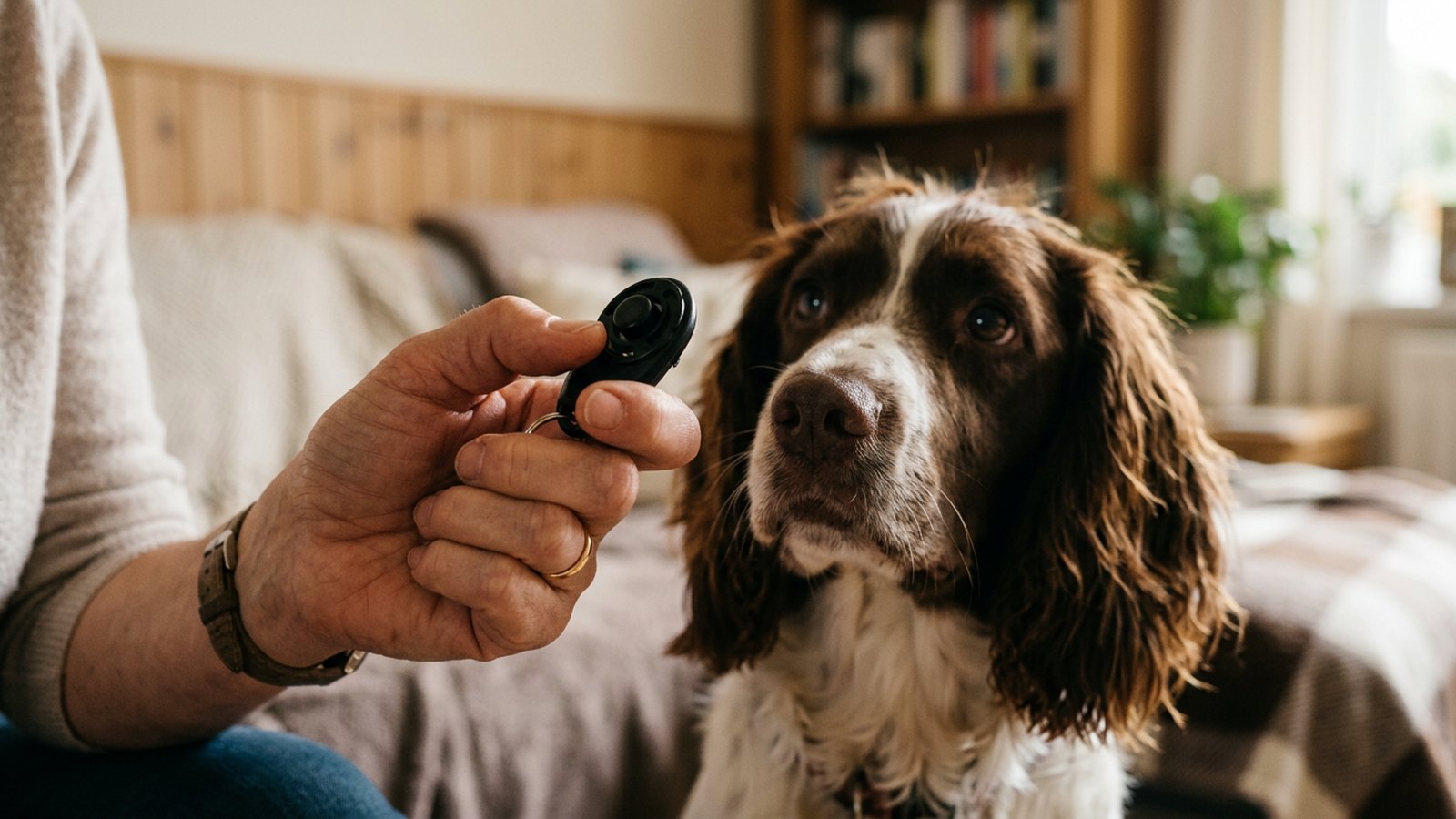
What a marker actually is
A marker is a signal that means exactly one thing to your dog: that, right there, is what earned the food. Karen Pryor sets the idea out on page 33 of Don't Shoot the Dog! (Bantam, 1985) under its technical name, the conditioned reinforcer. A sound carries no meaning on its own. It becomes meaningful only after it has been paired, many times, with something the dog already wants. Food is a primary reinforcer; no dog has to learn to like chicken. A click, or the word "yes," is learned.
That is the entire mechanism. There is nothing in the click itself — no special frequency, no magic in the metal. The marker is a bookmark. It points at one moment in time and says: the payment is for this one.
Which also tells you what a marker is not. It is not a cue, not a recall, and not a warm "good boy" drawn out over fifteen seconds while you scratch the dog's ears. A cue asks for a behaviour. A marker reports on a behaviour that has already happened. Blur the two and your dog still learns something, just not the thing you had in mind.
The problem it solves: food is always late
Here is the situation a marker was invented for. You ask for a sit. The dog's back end touches the floor for a fraction of a second, then the head comes up, then the front paws shuffle, then the nose swings toward your pocket. Meanwhile you are reaching for a treat, finding the treat, getting it out of the bag. By the time the food arrives, three or four other things have happened. The food lands on whichever one was last.
You can try to be faster. You will lose. Human hands do not move at the speed of a dog changing its mind. Reward-based training depends on the reward being clearly attached to something, and in real life it almost never is.
A marker separates the two jobs. The signal is on time; the food is allowed to be late. Say "yes" the instant the rump lands, and the dog now has a bookmark on the correct moment. You can take three seconds fishing for the treat and nothing is spoiled, because the marker has already done the pointing.
Practical take: Mark the moment, then deliver. Do not hold the sound until your hand is in the treat pouch — that just marks your hand in the pouch.
Charging the marker before you use it
A marker that has not been paired with anything is just a noise. Before it can do any work, you build the association deliberately. This is usually called charging or loading the marker, and it takes very little time.
- Sit down with your dog and a bowl of small, soft treats. Ask for nothing.
- Make the sound. Half a second later, hand over a treat.
- Pause a few seconds so the pairing stays distinct, then repeat.
- Stop while the dog is still keen.
You will know it has taken when the sound alone makes the dog's head snap round in expectation. At that point the marker has value of its own and can be used at a distance, mid-movement, or on a dog facing away from you.
Keep these sessions short. Pryor notes on page 65 of Don't Shoot the Dog! that appetite for reinforcement falls away after roughly a dozen reinforcements, and she puts an upper bound of around eighty reinforcements in a day. A loading session of a dozen repeats, done two or three times across a day, does more than one long grinding block that ends with a bored dog.
Clicker, verbal marker, or just the word "yes"
The clicker's advantages are mechanical rather than mystical. It sounds the same every time, it carries no emotional tone, and it is not a sound the dog hears in any other context. Your voice does none of that reliably. "Yes" said while you are cheerful and "yes" said while you are tired are different sounds to a dog, and "yes" is a word you say on the phone forty times a day.
Against that: you always have your voice, you cannot leave it in the other coat, and it works when both hands are full of lead, poo bag and phone. A tongue click or a short sharp word like "tick" splits the difference — consistent, uncommon, always with you.
Whatever you choose, use one marker and keep it clean. It should mean food is coming, every time. If you want the specific evidence on clickers against other methods, we cover it separately in what the research actually says about clicker training.
Never mark and then not pay. A marker that sometimes means nothing stops being a marker. If you click by accident, or mark the wrong thing, feed the dog anyway and carry on. Your mistake costs one treat; an unreliable marker costs you the tool.
What the research shows for ordinary pet dogs
This is where honesty is more useful than enthusiasm. Gilchrist and colleagues, writing in PeerJ in 2021, ran two controlled studies with pet dogs on simple tasks. The clicker produced no advantage — not over food alone, and not over a verbal marker. Dogs learned the task either way.
That result is not a reason to dismiss markers, but it should change how they are sold to you. If the task is easy, the dog is right in front of you, and the food is already in your hand, a marker is not adding much. The food itself is arriving fast enough to do the pointing. Teaching a sit in your kitchen is exactly that kind of task.
It is worth being clear about what these studies did and did not test. They looked at straightforward behaviours in companion dogs over short training periods. They did not test complex chains, long working distances, or multi-week programmes, and a null result on an easy task is not evidence that markers fail everywhere. It is evidence that the easy case does not need them.
What changes when the task gets hard
The contrast comes from working dogs. Lazarowski and colleagues, in Frontiers in Veterinary Science in 2025, randomly assigned 28 detection dogs to train with or without a marker on a difficult task with a long delay before the reward arrived. The marker group reached the final stage in 36 trials; the group without a marker needed 68. Alert accuracy came out at 92% with a marker against 69% without.
That is a large difference, and it fits the mechanism exactly. A detection dog indicates on a scent, then waits while a handler walks over. The reward cannot be immediate. Something has to bridge the gap, and a marker is the only thing that can.
So the honest reading is this: a marker earns its keep in proportion to how late the reward has to be. Close work with fast food — little benefit. Distance, duration, a dog working away from you, a behaviour you cannot reward on the spot — real benefit. Recall across a field, a settle on a mat at the other end of the room, a calm pass of another dog on a walk while you sort out the lead in your other hand: those are the cases worth the effort.
Two caveats stay attached to the detection-dog result. It is one study, and detection dogs are selected, experienced animals working in structured sessions. Whether the same size of effect shows up in a pet dog learning a hard behaviour in a kitchen has not been tested.
The timing mistakes that undo it
Most markers fail on handling, not on theory. The ones worth watching for:
- Marking late. You mark what the dog is doing, not what you wanted it to be doing. Mark a recall as the dog arrives and you may be marking the turn away.
- Marking twice. One event, one mark. Repeating it to be encouraging blurs the moment you were pointing at.
- Using the marker to get attention. A marker reports; it does not summon. If you click to make the dog look at you, you have taught that ignoring you produces clicks.
- Marking and then correcting. Mark, pay, move on. Anything else after the mark poisons it.
- Marking effort instead of the behaviour. Enthusiasm is not a criterion. Pick one thing to mark and stick to it for the session — Pryor's second law of shaping is to train one aspect at a time.
Timing is a physical skill, and it improves with feedback rather than reading. Tavi's own training sessions ask you to mark within about a second of the behaviour; that one-second target is our design choice for practice, not an established figure from the literature, and no dog-specific interval has been established. Practise on something easy before you need it on something hard. Tavi's training module breaks each skill into illustrated reps so you can see what you are meant to be marking before the dog is in front of you.
Once the marker is solid, it becomes the foundation for the schedule work — moving off a treat for every rep, and the occasional out-of-proportion payout that Pryor describes on page 31. All of that depends on the dog knowing precisely which moment is being paid for.
Practise marker timing with illustrated reps for your dog
Tavi's training module orders skills by your dog's breed, age and how much training you have done before, so you are not starting where a stranger's plan says you should. Every rep is illustrated, and sessions run a few minutes. Free for your first pet.
Frequently asked questions
What is marker training in dogs?
Marker training is teaching a dog that one specific signal always means food is coming for whatever they just did. The signal can be a clicker, a word like yes, or a tongue click. Karen Pryor describes it as a conditioned reinforcer: a sound that means nothing until it has been paired repeatedly with something the dog already wants. The point is speed. You can make a sound the instant the behaviour happens, which you can almost never do with a treat, so the marker does the pointing and the food can arrive a little later.
Does marker training actually work, or is it hype?
Both, depending on the task. Gilchrist and colleagues, in PeerJ in 2021, ran two controlled studies in pet dogs on simple tasks and found no advantage for a clicker over food alone or over a verbal marker. But Lazarowski and colleagues, in Frontiers in Veterinary Science in 2025, trained 28 detection dogs on a hard task with a long reward delay: the marker group got there in 36 trials against 68, with 92% alert accuracy against 69%. Markers pay off when the reward cannot be immediate.
Do I need a clicker, or can I just say yes?
A word works. The clicker's advantage is consistency: it sounds identical every time, carries no tone of voice, and the dog never hears it anywhere else. Your voice varies with your mood, and yes is a word you use constantly in ordinary conversation. Against that, your voice is always with you and leaves both hands free. A short uncommon word or a tongue click gets most of the clicker's consistency without the hardware. Pick one, keep it clean, and use it only as a marker.
How long does it take to charge a marker?
Usually minutes, not days. Sit with a bowl of small treats, make the sound, hand over a treat about half a second later, pause, repeat. You will know it has worked when the sound alone makes your dog's head turn in expectation. Keep sessions short: Pryor notes that appetite for reinforcement drops off after roughly a dozen reinforcements, so a dozen repeats two or three times across a day beats one long session. Recharge it occasionally by marking and paying for free.
What happens if I mark the wrong thing?
Feed the dog anyway. A marker only works because it is completely reliable, so a mark that sometimes produces nothing weakens the whole system. One wasted treat costs you almost nothing; an unreliable marker costs you the tool. Reset, get the behaviour again, and mark it properly next time. The same applies if you click by accident. If your timing is consistently off, work on something easy and predictable, where you can see the moment coming, before using the marker on harder behaviours.
Tavi's guides are informational and not a substitute for professional veterinary advice, diagnosis or treatment. When in doubt, call your veterinarian.
Sources
- Gilchrist et al., PeerJ (2021)
- Lazarowski et al., Frontiers in Veterinary Science (2025)
- Karen Pryor, Don't Shoot the Dog! (Bantam, 1985)