Clicker Training for Dogs: What the Research Actually Says
Start here
A clicker is a marker: a sound that always means food is coming. The evidence for it is genuinely mixed, and worth saying so. In pet dogs on simple tasks, a clicker beat neither food alone nor a spoken word. In detection dogs on a hard task with a long delay before the reward, a marker helped a great deal. Use one when there is a gap to bridge.
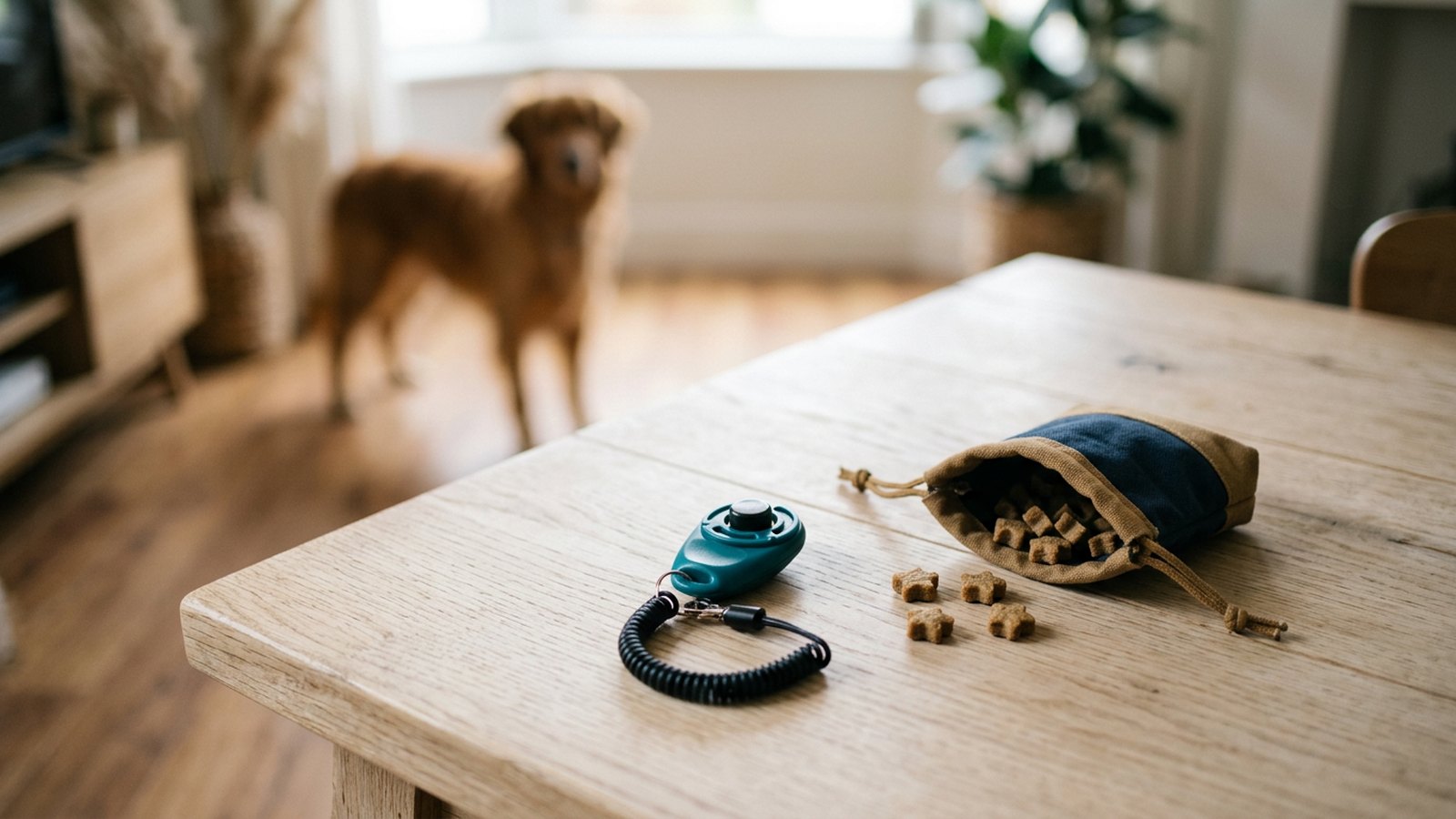
What a clicker mechanically does
Press the metal tongue and the box makes a short, sharp sound that is identical every single time. It is not louder when you are pleased and not flatter when you are tired. That sameness is the only thing a clicker offers that your voice cannot.
The sound means nothing to a dog on its own. It becomes meaningful by being paired, over and over, with food. Karen Pryor set out the underlying idea in Don't Shoot the Dog! (Bantam, 1985); on p. 33 she defines the conditioned reinforcer, a signal that acquires value because it reliably predicts something the animal already wants. The click is not the payment. It is the receipt.
So it has two jobs: it tells the dog which instant earned the food, and it promises the food is coming. A spoken word does both jobs too, which is exactly where the argument starts. If you want the mechanism in full, the companion piece on marker training walks through it step by step.
The claim versus the evidence
Search this topic and you will be told a clicker teaches faster, marks more precisely, and produces cleaner behaviour than praise ever could. Some of that is reasonable theory. Rather less of it is settled evidence.
Research on clickers specifically, as opposed to reward-based training in general, is thin. Two well-designed controlled studies stand out, and they point in different directions. Most pages quote whichever one suits them. Both are below with what each actually tested, because the conditions are where the answer lives.
Practical take: Buy a clicker because it solves a problem you actually have in your training. Don't buy one because a page told you it is scientifically proven to be faster, because on ordinary household tasks that claim has not held up.
Gilchrist 2021: no advantage in pet dogs
Gilchrist and colleagues published two controlled studies together in PeerJ (2021), run with pet dogs on simple tasks. They set a clicker against food alone, and against a verbal marker. The clicker gave no advantage over either one.
Read that precisely, because it is easy to over-read in both directions. The dogs in the clicker groups learned perfectly well. Clicker training worked. It simply did not work better than handing the dog a treat, or better than saying a word and then handing the dog a treat. On the kind of task most owners are actually training, a sit or a down or a nose touch with a treat pouch on your hip, the device added nothing the researchers could measure.
That the paper reports two studies rather than one matters. A single null result is easy to wave away as an underpowered miss; two, run deliberately as a pair, is harder to dismiss. It is still pet dogs, still simple tasks, and it tells you nothing about anything else.
Don't flip a null result into “clickers don't work.” A study that finds no difference between two methods has not found that one of them fails. If your dog is learning happily with a clicker in your hand, nothing in this research is a reason to stop.
Lazarowski 2025: where a marker clearly earned its keep
Lazarowski and colleagues, in Frontiers in Veterinary Science (2025), took 28 detection dogs and randomly assigned them to train either with a marker or without one. The task was hard by design: a demanding scent problem with a long delay between the dog's correct response and the reward actually arriving.
The gap was not subtle. Dogs trained with a marker reached the final stage of the protocol in 36 trials, against 68 trials for the dogs trained without one. Alert accuracy came out at 92 percent with the marker and 69 percent without it.
Hold two caveats alongside those numbers. Twenty-eight dogs is a small sample, and these were detection dogs worked by people who train for a living, not family pets on a kitchen floor. Treat it as a strong signal about a particular set of conditions rather than a general law about clickers.
Why those two results are not a contradiction
Three things separate the studies, and each one predicts the result it got.
- Population. Pet dogs in a familiar setting, versus working detection dogs running a formal protocol with experienced handlers.
- Task complexity. Sitting on cue is one decision. A demanding scent problem is a chain of them, and the dog has to work out which link in the chain earned the pay.
- Delay before the reward. This is the one that does most of the work. If the treat is already in your hand and reaches the dog's mouth in the same breath, the food is its own marker. There is no gap, so a bridge across the gap adds nothing. Stretch the delay out and the dog has to guess which moment the reward refers to, and closing exactly that gap is what a conditioned reinforcer is for.
A fair reading of both papers is therefore narrow and useful. A marker earns its keep when the reward cannot arrive immediately, or when the behaviour is hard to isolate from everything around it. It is largely redundant when the reward can arrive immediately and the behaviour is obvious. That is a smaller claim than the marketing makes, and a far more reliable one.
So should you use one? A practical answer
Use a clicker when one of these is true:
- You are shaping a behaviour in small steps and need to pin down a precise moment, such as a paw lift or the instant a nose touches a target.
- You are working at a distance, or the reward has to travel to the dog rather than appear instantly.
- Your timing with words is inconsistent, or your voice changes with your mood in ways the dog reads.
Skip it when the treat is already in your hand and the behaviour is a plain sit, down or recall; when juggling a clicker, a lead and a treat pouch means you fumble all three; or when several people will train the dog and only one will remember to carry it. A word you always have with you often beats a device you leave on the hall table.
Keep the clicker question in proportion. What is well evidenced is not clicker versus word, but reward versus punishment. In a controlled trial of 63 dogs, China, Mills and Cooper (Frontiers in Veterinary Science 7:508, 2020) found reward-trained dogs came back on the first cue 82.5 percent of the time against 71.0 percent for dogs trained with electronic collars, p = 0.015, and sat faster afterwards, 1.36 seconds against 1.67. Vieira de Castro and colleagues (PLOS ONE 15(12), 2020), following 92 companion dogs through three training schools, counted mean lip-licking at 55.9 in the aversive group against 4.1 in the reward-based group, an effect size of d = 3.9, with elevated cortisol and a more pessimistic reading of an ambiguous situation weeks later. Those trials cover obedience tasks such as recall and sit, and should not be stretched past that. Still, the gap they describe is far larger than anything the clicker literature shows, which is why how you reward deserves more of your attention than what you mark with.
How to use a clicker correctly if you do
- Charge it before you train with it. Click, then feed, with no behaviour asked for, until the sound alone makes the dog's head turn. Until then the click is just noise.
- One click, not a burst. Clicking three times does not mean the dog did well. It means the marker is no longer a single clean signal.
- Always feed after a click, even a mistaken one. If you click the wrong thing, pay it anyway and move on. A click that sometimes means nothing stops meaning anything.
- The click ends the rep. The dog is allowed to break position once you have clicked, so mark the moment you wanted, not the moment you finally got the treat out.
- Fade the food, not the click. Once a behaviour is fluent, move it onto a variable schedule; Pryor's argument at pp. 36–40 is that an unpredictable payoff, the slot-machine effect, makes a habit stronger and harder to extinguish. An occasional jackpot, an out-of-proportion reward (p. 31), is worth keeping in reserve.
On timing, be sceptical of anyone who gives you a precise interval. Pryor offers no dog-specific number and, as far as we can find, none is established in the literature. Tavi's app teaches a one-second target because a concrete goal is easier to practise than “as fast as you can”, but that is our own design choice, not a research finding. Mark as close to the behaviour as you can manage and stop worrying about milliseconds.
Keep sessions short. Pryor notes (p. 65) that an animal's appetite for reinforcement falls away after roughly a dozen reinforcements, with an upper bound of around 80 in a day, which is a good deal less training than most enthusiastic owners imagine they are doing. Two or three short sessions beat one long one, and the same restraint applies whether you are clicking, saying “yes”, or working through something frustrating like loose-leash walking. Tavi's training module sequences the reps for you so you are not inventing the next step mid-session.
Never use the clicker to get your dog's attention. Clicking at a dog who is ignoring you teaches that the sound is a summons rather than a receipt, and it quietly marks whatever the dog was doing at the time. If you need attention, use a name or a kissy noise, and keep the click for behaviour you actually want to pay for.
Practise clean marker timing with reps built for your dog
Tavi's training module orders skills by your dog's breed, age and your own experience, so the marker always has something worth marking. Every rep is illustrated, which shows you the moment to mark rather than describing it, and sessions run a few minutes. Free for your first pet.
Frequently asked questions
Does clicker training actually work better than just saying yes?
On simple household tasks, the evidence says no. Gilchrist and colleagues ran two controlled studies with pet dogs, published in PeerJ in 2021, and found a clicker gave no advantage over food alone or over a verbal marker. The dogs learned either way. Where a marker does show a clear edge is on hard tasks with a long delay before the reward arrives, which is the situation Lazarowski and colleagues tested in detection dogs. For a sit in your kitchen, a word you always have with you is fine.
How soon after the behaviour do I need to click?
As close to the moment as you can manage, but be wary of anyone quoting you a precise interval. Karen Pryor gives no dog-specific timing figure, and we could not find an established one in the research either. Tavi's app teaches a one-second target because a concrete goal is easier to practise than being told to go as fast as possible, but that is our own design choice rather than a finding from a study. Consistency matters more than milliseconds. Marking the wrong moment is the real problem, not being slightly late.
Do I have to carry a clicker forever?
No. The clicker is a teaching tool for the period when you are building or refining a behaviour, not a permanent fixture. Once a behaviour is fluent you move the food onto a variable schedule and the marker naturally drops out of everyday use, kept back for new skills or for sharpening something that has gone sloppy. Many owners switch to a spoken marker for daily life and pick the clicker up again only when they are shaping something fiddly. Both are fine. Neither the dog nor the research is precious about it.
Will the clicker sound frighten a noise-sensitive dog?
It can. Some dogs flinch at the sharpness of a standard box clicker, and a dog who is worried about the marker is learning something you did not intend. Quieter options exist, including softer button clickers and simply muffling the click in a pocket or behind your back at first. A spoken marker is also a perfectly good substitute, and the Gilchrist research found no measurable penalty for using one in pet dogs. If your dog startles at ordinary household sounds more generally, that is worth mentioning to your vet.
Can I use clicker training for barking, reactivity or aggression?
Markers are a way of teaching a behaviour, not a treatment for an emotional problem, and the controlled trials people cite in this area cover obedience tasks such as recall and sit. Nothing in that evidence supports a claim that clicker work resolves aggression. A marker can help you build and pay a calm alternative behaviour, which is often part of a plan. The plan itself, especially where a dog is frightened, reactive or has bitten, belongs with your vet or a qualified behaviourist rather than with a gadget and a video.
Tavi's guides are informational and not a substitute for professional veterinary advice, diagnosis or treatment. When in doubt, call your veterinarian.
Sources
- Gilchrist et al., PeerJ (2021)
- Lazarowski et al., Frontiers in Veterinary Science (2025)
- China, Mills &
- Cooper, Frontiers in Veterinary Science 7:508 (2020)
- Vieira de Castro et al., PLOS ONE 15(12) (2020)
- Karen Pryor, Don't Shoot the Dog! (Bantam, 1985)