How to Stop Unwanted Dog Behaviour Without Punishment
Start here
Stopping a behaviour without punishment rests on three moves: train a behaviour the dog cannot do at the same time as the unwanted one, take away whatever the habit is earning, and change the setup so it stops being rehearsed. Punishment suppresses without teaching, and the controlled trials below show it costs you reliability and calm. Fear, aggression or guarding needs a qualified behaviourist.
Why "just say no" is not a training plan
"No" is asked to do two jobs at once. It has to interrupt the dog in the moment, and it has to teach something better for next time. A single syllable delivered in irritation does the first job briefly and the second not at all. Most owners reach for it anyway. In Hiby, Rooney and Bradshaw's survey of 364 owners (Animal Welfare, 2004), 66% reported using vocal punishment, which was more than the 60% who used praise and the 51% who used food rewards.
The harder truth underneath is that unwanted behaviours are not mistakes. They are behaviours that work. Counter-surfing produces cheese. Barking at the window is followed by the delivery driver leaving. Jumping up produces hands, faces and noise all at once. Something is paying for the behaviour, and a word from across the room does not stop the payment arriving. So the question is never how to make him stop. It is what this earns him, and what you want him doing instead.
Practical take: Name the payoff before you name the fix. If you cannot say what the behaviour earns the dog, you are guessing, and you will probably guess punishment.
Pryor counts eight ways to end a behaviour and rates only four
Karen Pryor's Don't Shoot the Dog! (Bantam, 1985) lays out eight methods for ending a behaviour you do not want, across pages 102 to 110. The interesting part is not the list. It is her verdict on it: she judges only four of the eight to be kind or reliable, and punishment is not one of those four.
Punishment appears on the list because it is a thing people do and it sometimes suppresses behaviour in the short run, not because it earns its place. Suppressing a behaviour and teaching an alternative are different projects, and only one of them holds up when the dog is excited, distracted or somewhere new.
We are not going to reproduce all eight here, and it is worth saying why. Our reading notes confirm the count and Pryor's verdict, but they do not itemise the eight by name, and filling that gap with plausible inventions would be wrong. What follows are three approaches we can describe accurately, including Pryor's method five. For the framework they sit inside, see our guide to the four quadrants of dog training.
Train an incompatible behaviour (Pryor's method five)
Pryor's fifth method is to train a behaviour that physically cannot happen at the same time as the one you want gone. You never have to argue with the dog about the unwanted behaviour; you make the other thing more worth doing. A dog looking up at your face cannot simultaneously be swallowing the chicken bone on the pavement. A dog with four feet on the floor is not jumping. The incompatibility does the enforcing for you.
- Scavenging on walks gets a trained head-turn back to you on a cue.
- Jumping up gets a sit, or a go-to-mat, at the moment the guest appears.
- Barking at the window gets a recall to a bed in another room, which is also the plan in our guide on how to stop dog barking.
- Lunging at the end of the lead gets a loose-lead position paid well, which is the whole method in loose-leash walking.
The catch is that the replacement has to be genuinely fluent before you ask for it under pressure. A sit that works in a quiet kitchen is not yet a sit that works with a visitor on the doorstep. Build it in an empty room first, pay it properly, and only then take it to the situation that matters. The mechanics of paying it properly are in our guide to positive reinforcement dog training.
Take away what the behaviour is earning
If a behaviour is being paid, stopping the payment will eventually end it. This is the honest version of "ignore it". It works cleanly when you actually control the reinforcer: the dog barks at you for attention and you control attention; the dog nudges your elbow at dinner and you control dinner. It works badly when you do not. Barking at a passer-by is reinforced by the passer-by walking on, and you cannot switch that off from the sofa.
Two things make this harder than it sounds. Behaviour usually gets worse before it goes, because the dog tries louder and longer when the usual payment fails to arrive. And there is Pryor's slot-machine argument (pp. 36 to 40): an intermittent, unpredictable payoff makes a habit stronger and harder to extinguish than a reliable one. So the worst response is to ignore the whining for ten minutes and then give in. That does not end the behaviour, it teaches it to persist.
Do not try to extinguish a behaviour you cannot afford to have repeated. Ignoring does not work on anything that pays itself: raiding the bin, chewing the skirting board, chasing squirrels. Nor is it the right tool for growling, snapping or guarding, where the behaviour is communication and suppressing it removes your warning system.
Removing the reinforcer is at its best paired with the section above. Stop paying the old behaviour, pay the incompatible one generously, and the dog has somewhere to go.
Manage the setup so the rehearsal stops
Every repetition of a behaviour makes it more fluent. That is true of a sit and equally true of counter-surfing. So the least glamorous tool on this page is often the fastest: change the environment so the dog cannot practise.
A bin with a lid. A baby gate across the kitchen doorway. Frosted film on the bottom half of the window the dog patrols. A house line clipped on for the twenty minutes guests are arriving. None of this is training, which is why people dismiss it. Dismissing it is a mistake: management buys the weeks you need for the replacement behaviour to become real, and stops the old habit getting stronger meanwhile. A dog who has not rehearsed bin-raiding for a month is far easier to train than one who got a chicken carcass on Tuesday.
Practical take: Treat management as scaffolding with a removal date, not a permanent fix. Put the gate up on day one, and take it down in stages once the trained alternative holds without it.
A worked example: jumping up on guests
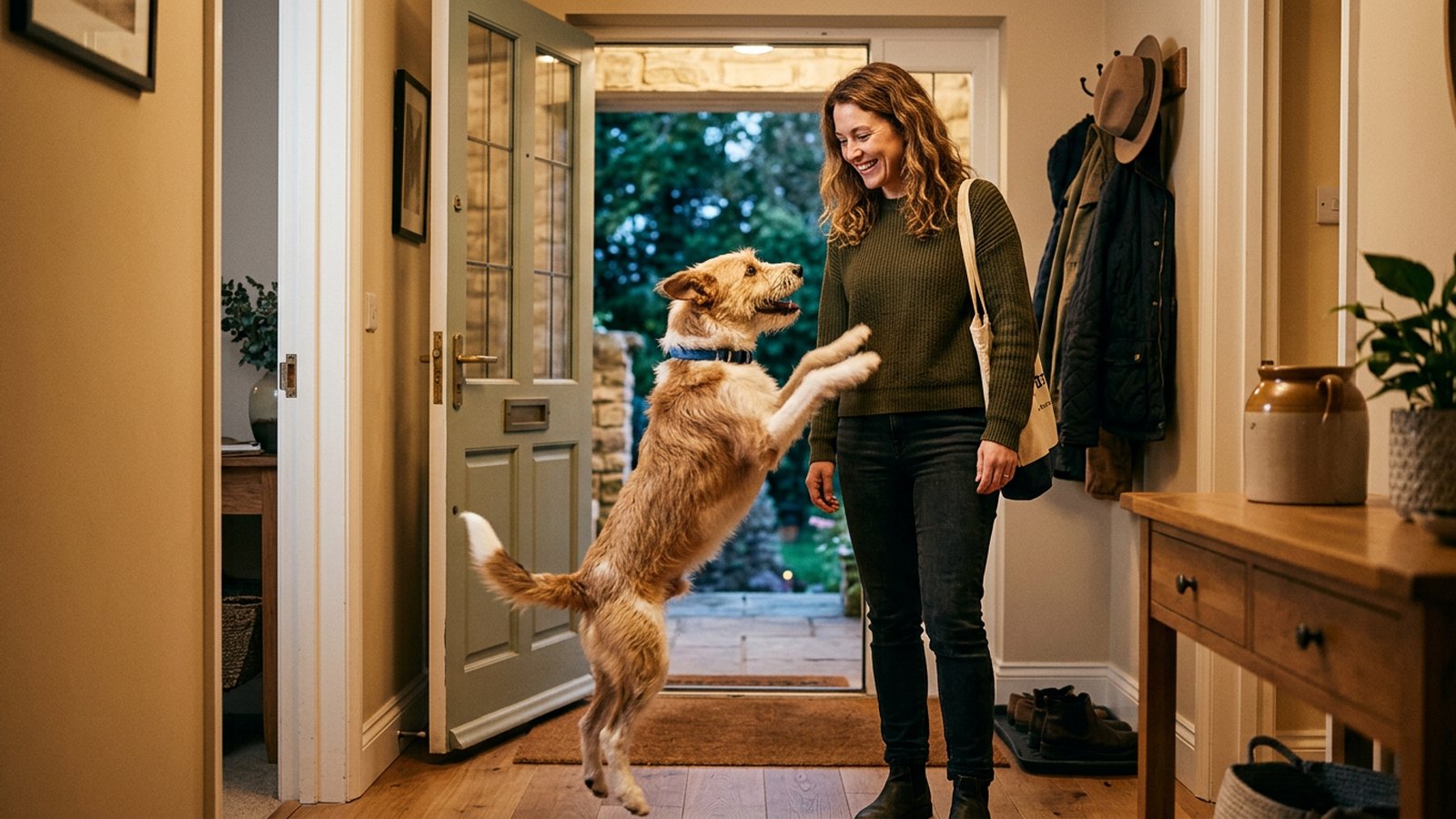
Jumping up is the classic case because all three tools apply at once, and because shouting at a jumping dog is itself attention, which is the exact thing the dog wanted.
- Name the payoff. Jumping produces hands, faces, voices and movement. Guests supply all four for free.
- Manage first. For the next few weeks the dog is behind a gate or on a house line when the doorbell goes. No more rehearsals at the door.
- Build the incompatible behaviour cold. Teach a solid go-to-mat, or a sit-for-greeting, in a quiet room with nobody visiting. Pay it well and often until it is automatic.
- Remove the reinforcer for the old behaviour. Brief the guest: front feet leave the floor and they turn away and stand still. Four feet down, they engage again. The dog gets a clear, instant rule.
- Bring the two together. Guest comes in, dog is already on the mat and gets paid there, guest greets him on the mat. Add difficulty in small steps: one calm friend before three excited children.
- Fade the management. Drop the line, then the gate, when the mat holds without them. If it falls apart, put the gate back for a week.
That is the shape of every plan on this page, and roughly how Tavi's training module sequences a skill: one criterion at a time, in an order the dog can follow. The same structure applies to puppy biting and nipping, where the incompatible behaviour is a mouth full of tug toy.
What the research actually says about the punishment route
Two controlled studies are worth knowing by name, because they are the ones that turn a matter of taste into a matter of evidence.
China, Mills and Cooper (Frontiers in Veterinary Science 7:508, 2020) ran 63 dogs in three matched groups, comparing reward-based trainers against trainers using electronic collars. The reward-based dogs came back on the first cue 82.5% of the time against 71.0% for the e-collar group (p = 0.015), and sat faster once they arrived, 1.36 seconds against 1.67. The punishment route did not win on the thing it is usually defended for, which is control.
Vieira de Castro and colleagues (PLOS ONE 15(12), 2020) followed 92 companion dogs from aversive, mixed and reward-based training schools. Mean lip-licking counts, a standard stress signal, ran 55.9 in the aversive group against 4.1 in the reward-based group, an effect size of d = 3.9. Cortisol was elevated in the aversive group, and weeks later those dogs read an ambiguous situation more pessimistically in a cognitive-bias test.
The survey data points the same way without proving cause: in Hiby 2004, the more tasks an owner trained by punishment, the more problem behaviours they reported. That is a correlation and could run either direction. Cooper and colleagues (2014) also found that owners using aversive methods reported higher confidence in them, which is a warning about trusting your own impression. The Complete Dog Breed Book (DK, 2nd edn, 2020, p. 322) is blunt: harsh handling "is simply not effective" and is "likely to cause more problem behaviours, including aggression and anxiety".
Be clear about the limits, though. These trials tested obedience tasks, recall and sit, in ordinary pet and working dogs. They are not evidence that reward-based methods resolve severe aggression, and nobody should claim they are. Our longer look at why punishment-based training backfires goes through the same studies in more detail.
When to stop and call a qualified behaviourist
Everything above assumes a nuisance behaviour in a dog who is otherwise comfortable. Some behaviours are not nuisances, and working on them from a page on the internet is the wrong move.
- Aggression of any kind: growling that escalates, snapping, biting, or a stare that goes still and hard. Start with the causes of dog aggression, then get help in person.
- Resource guarding around food, chews, beds or people. Taking the item away is the intuitive response and it reliably makes guarding worse.
- Fear that does not fade: cowering, freezing, hiding, refusing to move on walks.
- Separation distress, which is a panic problem rather than a training problem. See separation anxiety in dogs.
One more thing. A behaviour that changes suddenly in a dog who was fine last month, especially with irritability or a new reluctance to be touched, is worth a vet check before it is treated as a training issue. Pain changes behaviour, and no amount of good technique fixes a sore joint or a bad ear. A qualified behaviourist working on reward-based lines will assess your dog in context and build a plan you can actually run.
Train the replacement behaviour, one small step at a time
Tavi's training module orders skills by your dog's breed, age and your own experience, so the incompatible behaviour gets built in the right sequence instead of all at once. Every rep is illustrated, so you can see what the step should look like, and sessions run a few minutes. Free for your first pet.
Frequently asked questions
How do I stop my dog doing something if I can't say no?
You replace it rather than forbid it. Work out what the behaviour earns your dog, train a behaviour that cannot physically happen at the same time, pay that new behaviour generously, and change the environment so the old one stops being practised while you build the new one. Saying no is not banned, but on its own it interrupts without teaching, so the behaviour comes straight back the moment you are not watching.
Does ignoring bad behaviour actually work?
Sometimes, and only when you control what the behaviour is earning. Ignoring works for attention-seeking barking or nudging, because you are the payoff. It does not work for anything that pays itself, like bin-raiding, chewing or chasing. Expect the behaviour to get louder before it fades, and never give in partway through. Karen Pryor's point in Don't Shoot the Dog is that an unpredictable, occasional payoff makes a habit stronger and much harder to extinguish.
What is an incompatible behaviour?
It is a behaviour the dog cannot perform at the same time as the one you want to lose. A dog looking up at your face cannot be swallowing something off the pavement. A dog lying on a mat is not at the front door. Karen Pryor lists it as method five of eight in Don't Shoot the Dog, and it is the most useful of the approaches we can describe accurately. Train it somewhere quiet first, then use it where it matters.
Is a shout or a spray bottle really that bad?
The controlled evidence says it costs you more than it buys. China, Mills and Cooper found reward-trained dogs recalled on the first cue 82.5% of the time against 71.0% for dogs trained with electronic collars. Vieira de Castro's group found far higher stress signals in aversive-trained dogs and a more pessimistic outlook weeks later. DK's Complete Dog Breed Book states plainly that harsh handling is simply not effective. Suppression also hides warning signs you want to keep.
How long does it take to stop an unwanted behaviour?
It depends mostly on how long the behaviour has been rehearsed and how well it pays. A habit of a few weeks can shift quickly once the payoff stops and a replacement is trained. A habit of years takes longer and needs tighter management throughout. Judge progress by how often the dog offers the new behaviour without being asked, not by how rarely the old one appears, and expect setbacks in new places.
Tavi's guides are informational and not a substitute for professional veterinary advice, diagnosis or treatment. When in doubt, call your veterinarian.
Sources
- Karen Pryor, Don't Shoot the Dog! (Bantam, 1985), pp. 36-40 and pp. 102-110
- China, Mills & Cooper, Frontiers in Veterinary Science 7:508 (2020)
- Vieira de Castro et al., PLOS ONE 15(12) (2020)
- Hiby, Rooney & Bradshaw, Animal Welfare 13 (2004)
- Cooper et al. (2014)
- DK, The Complete Dog Breed Book, 2nd edn (2020), p. 322