Are Puppy Training Classes Worth It? What the Evidence Shows
Start here
Puppy classes are probably worth it, but for practical reasons more than proven ones. The research most often quoted is a 1996 case-control study that found never attending an obedience class was one risk factor among several for a dog ending up in a shelter. That is a correlation, not proof a class fixes anything. The real case for a class is what it gives you: a strange room, other dogs, and someone watching your timing.
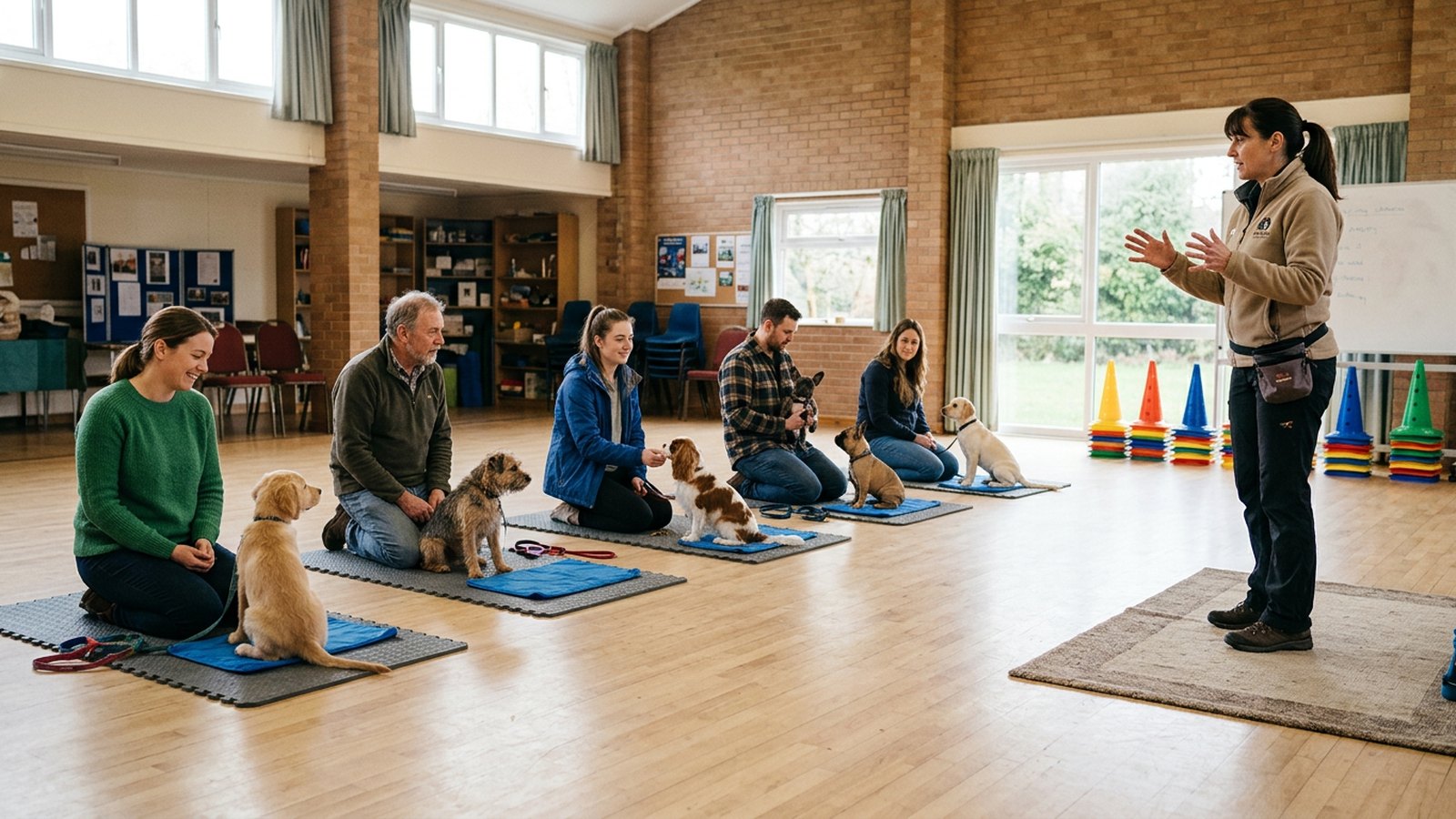
The question owners ask before paying
A six-week puppy course costs real money and books a fixed evening every week, usually during the exact months when you are also short on sleep. So the question is fair: does it actually change how the dog turns out, or is it a nice social outing with a certificate at the end?
The honest answer is that the evidence here is thinner than the advertising around it. Nobody has taken a few hundred puppies, randomly sent half of them to class, and followed both groups for five years. What exists instead is one much-quoted study on shelter relinquishment, a much stronger body of research on how dogs should be trained, and a lot of accumulated practical experience.
That means there are two separate arguments for a class, and they usually get blended together in the same sentence. One is the research claim. The other is the practical claim: a class puts you and your puppy in conditions you cannot recreate in your kitchen. The second argument is the stronger of the two, and it is the one worth paying for.
What the Patronek study actually found
The study behind almost every "classes reduce surrender" claim online is Patronek and colleagues, published in JAVMA (volume 209) in 1996. It was a case-control study: the researchers compared dogs that had been relinquished to a shelter with dogs still living in their homes, then looked at which household and dog characteristics differed between the two groups.
Several factors came out associated with relinquishment. Two are relevant to this page. One was frequent indoor accidents, which is why a reliable house-training routine matters more than it looks; our puppy potty training guide covers the schedule side of that. The other was the dog never having attended an obedience class.
That is a real finding from a real study, and it is worth knowing. It is also narrower than the way it usually gets repeated. The study identified risk factors present in a population. It did not test whether sending a given dog to class changes that dog's outcome, and we have no percentage to attach to it. If you see a specific figure quoted for how much classes reduce surrender, treat it with suspicion.
A risk factor is not a cause
This is the part most pages skip, so here it is plainly. Finding that class attendance and shelter relinquishment move together does not tell you which way the arrow points, or whether there is an arrow at all.
Think about who signs up for a puppy class. They tend to have the money, a car or a bus route, a free weeknight, and a household that agreed on getting a dog in the first place. They are often already the kind of owner who reads about training before the puppy arrives. Every one of those things could independently make a home more likely to keep its dog. The class is sitting in the middle of that cluster, and a case-control study cannot separate it out.
The arrow can also run backwards. A puppy who is already fearful, already reactive, or already too much to handle in public is a puppy whose owner quietly decides not to take them to a class hall. In that case the difficulty came first and the missed class came second.
Practical take: Treat class attendance as a marker that travels with good outcomes, not as a treatment that produces them. Book a class because of what happens inside the room, not because a study promised you an outcome it never measured.
What a class gives you that a video cannot
Here is the argument that does not depend on thin evidence. A puppy who sits beautifully in your hallway has learned to sit in your hallway. Dogs generalise poorly, and the gap between a behaviour at home and the same behaviour in a strange room full of smells is enormous. A class is a controlled way to close that gap every week.
Three things happen in a class hall that no screen provides:
- A novel environment. New floor, new smells, new noise. Practising a known cue there is how a cue becomes reliable rather than decorative.
- Other dogs, at a manageable distance. Your puppy learns to disengage from another dog and come back to you, which is the single most useful skill on a lead. That overlaps heavily with the window covered in our puppy socialization guide.
- Someone watching your hands. Almost every home training problem is a timing or a criteria problem, and you cannot see your own timing. A good instructor will tell you that your treat is arriving two seconds late, or that your puppy is being asked for duration and distance at once.
That third one is the real product. You are not buying the puppy's education. You are buying coaching for yourself, in front of a distracted dog, which is where training actually falls apart.
Choose the class by its method, not its price
A class is only as good as the method it teaches, and methods still vary a lot. Hiby, Rooney and Bradshaw surveyed 364 owners for Animal Welfare in 2004: 66% reported using vocal punishment, 60% praise, and 51% food rewards. They also found that the more tasks an owner trained using punishment, the more problem behaviours they reported. That last link is correlational, and the authors treat it as such, but it points the same direction as the controlled work.
The controlled work is clearer. China, Mills and Cooper, in Frontiers in Veterinary Science 7:508 (2020), ran three matched groups of 63 dogs in total and compared reward-based trainers with trainers using electronic collars. Dogs trained with rewards came back on the first cue 82.5% of the time versus 71.0% for the e-collar group (p = 0.015), and sat faster afterwards, 1.36 seconds versus 1.67. Reward training was not the softer, slower option. It worked better on the task being measured.
Vieira de Castro and colleagues, in PLOS ONE 15(12) (2020), followed 92 companion dogs across aversive, mixed and reward-based training schools. Dogs in the aversive schools showed far more stress signalling, with mean lip-licking counts of 55.9 against 4.1 in reward-based schools and a very large effect size (d = 3.9), along with elevated cortisol. Weeks later, in a cognitive-bias test, those dogs read an ambiguous situation more pessimistically. Our guide on why punishment-based training backfires goes through those results in more detail, and positive reinforcement dog training covers the mechanics of the alternative.
One caveat worth stating: these trials measured ordinary obedience tasks such as recall and sit. They do not tell you what works for severe aggression, which is a separate problem and a job for a qualified behaviourist rather than a group class.
What to ask before you hand over the money
Most of what separates a good class from a poor one is visible before you enrol. Ask these, and ask to watch a session without your puppy first. Any instructor worth paying will say yes.
- What happens when a dog gets it wrong? The answer should be about making the next repetition easier, not about correcting the dog.
- What equipment is required or banned? Flat collar or harness and a normal lead is the answer you want.
- How many puppies, and what age range? Small groups, narrow age bands, and enough space to keep dogs under threshold.
- What happens to the puppy who is frightened? A good instructor has a screen, a corner, and a plan. A poor one tells you the puppy needs to get used to it.
- What do I practise at home between sessions? The class is one hour a week. The other hours are where the learning sticks.
Walk out of any class that uses electronic collars, prong collars, choke chains or lead corrections as its teaching method. The DK Complete Dog Breed Book is blunt about harsh handling: it "is simply not effective" and is "likely to cause more problem behaviours, including aggression and anxiety". It also rates choke chains as ineffective for disobedience. Cooper and colleagues (2014) found something worth remembering here, which is that owners using aversive methods reported higher confidence in them. Confidence is not evidence, and a trainer's certainty tells you nothing about their results.
If there is no class you can get to
Waiting lists, rural addresses, cost, shift work, and a socialization window that will not wait are all real. A class is not the only route, and the Patronek finding certainly does not mean a dog who never attends one is destined for a shelter. What matters is copying the three ingredients the class provides.
For the novel environment, train in five different places rather than one: the driveway, a quiet car park, a friend's kitchen, a bench outside a shop, the vet's waiting room. For other dogs, work at a distance where your puppy can still eat and still hear you, and shrink that distance over weeks rather than minutes; the same principle drives our loose-leash walking guide. For coaching, film 60 seconds of yourself on your phone and watch where your reward lands relative to the behaviour. It is uncomfortable and it works.
A structured plan helps here more than any single tip, because the common failure without a class is not bad technique. It is drift: three skills started, none finished. Tavi's training module sequences the skills so you always know what this week's rep is, which is the part an instructor would otherwise be doing for you. A one-to-one session with a reward-based trainer, even just two or three of them, is also usually cheaper than people assume.
The honest bottom line
What we can say: never attending an obedience class was one of several factors associated with relinquishment in the 1996 Patronek study, and reward-based methods outperform aversive ones on the obedience tasks that have been tested, with less stress. What we cannot say: that a class prevents a dog being given up, or that any particular share of surrenders would be avoided by attending one. The study design does not support that sentence, and neither do we.
So book the class for what it demonstrably does. It puts your dog in a hard environment, gives you a weekly deadline, and puts a trained pair of eyes on your timing. If your puppy is showing something a class cannot address, such as real fear, sustained defensive behaviour, or a sudden change in temperament, that is worth a vet check first to rule out pain before it is treated as a training problem.
Keep the class going at home between weekly sessions
Tavi's training module orders skills by your dog's breed, age and how much training you have done before, so the home practice fits the dog in front of you. Every repetition is illustrated, and a session takes a few minutes. Free for your first pet.
Frequently asked questions
Do puppy classes actually prevent behavior problems?
No study shows that they prevent them. The 1996 Patronek study in JAVMA found that never having attended an obedience class was one of several factors associated with a dog being relinquished to a shelter, but that is a correlation found in a case-control design, not proof that the class itself changed anything. Owners who attend classes differ from owners who don't in income, time, transport and prior interest in training. The better reason to attend is practical: a class gives you a distracting environment, other dogs at a safe distance, and a coach watching your timing.
At what age should a puppy start training classes?
Most reward-based puppy classes take dogs from around eight weeks, subject to whatever vaccination policy the venue and your vet agree on. Earlier is generally better, because the sensitive period for socialization closes early and a well-run class is a safe, controlled way to use it. Ask the instructor what their vaccination requirement is and check it against your vet's advice for your area. If your puppy is past that window, classes are still useful, the goals just shift toward confidence in new places rather than first exposure.
Are puppy classes worth the money if I've trained a dog before?
Often yes, for a reason that has nothing to do with knowing the exercises. Experience teaches you what to do, but it can't show you your own timing, and timing is where most home training quietly fails. A class also supplies something you cannot build at home: a strange room with other dogs in it. If you genuinely only want the distraction practice, some trainers sell drop-in proofing sessions or a short block of one-to-one work, which costs less than a full course.
What should a good puppy class look like?
Small groups, a narrow age range, enough floor space that dogs can stay under threshold, and food rewards in constant use. Mistakes should be answered by making the next repetition easier, not by correcting the dog. There should be a screen or a quiet corner for a puppy who is overwhelmed, and homework for the week. Equipment should be a flat collar or harness and an ordinary lead. Ask to observe a session before you enrol; a good instructor will welcome it, and ten minutes of watching tells you more than any website.
Can online training replace a puppy class?
It can replace the instruction, but not the environment. A video can teach you the mechanics of a sit, a recall or loose-lead walking perfectly well, and structured home practice is genuinely effective. What it cannot give you is a hall full of unfamiliar smells, other puppies to disengage from, and someone telling you that your reward is arriving two seconds late. If you train at home, deliberately rotate through five different locations, work near other dogs at a distance your puppy can handle, and film yourself occasionally.
Tavi's guides are informational and not a substitute for professional veterinary advice, diagnosis or treatment. When in doubt, call your veterinarian.
Sources
- Patronek et al., JAVMA 209 (1996)
- China, Mills & Cooper, Frontiers in Veterinary Science 7:508 (2020)
- Vieira de Castro et al., PLOS ONE 15(12) (2020)
- Hiby, Rooney & Bradshaw, Animal Welfare 13 (2004)
- Cooper et al. (2014)
- DK, The Complete Dog Breed Book, 2nd edn (2020)