Stimulus Control: Why Your Dog Obeys at Home but Not Outside
Start here
Your dog sits instantly in the kitchen and ignores you at the park because the sit is not yet under stimulus control. It is under the control of the kitchen. Karen Pryor sets out four conditions a cue has to meet before it works anywhere, and reaching them takes deliberate practice in new places, not a firmer tone. Most everyday behaviours never fully get there, and that is normal.
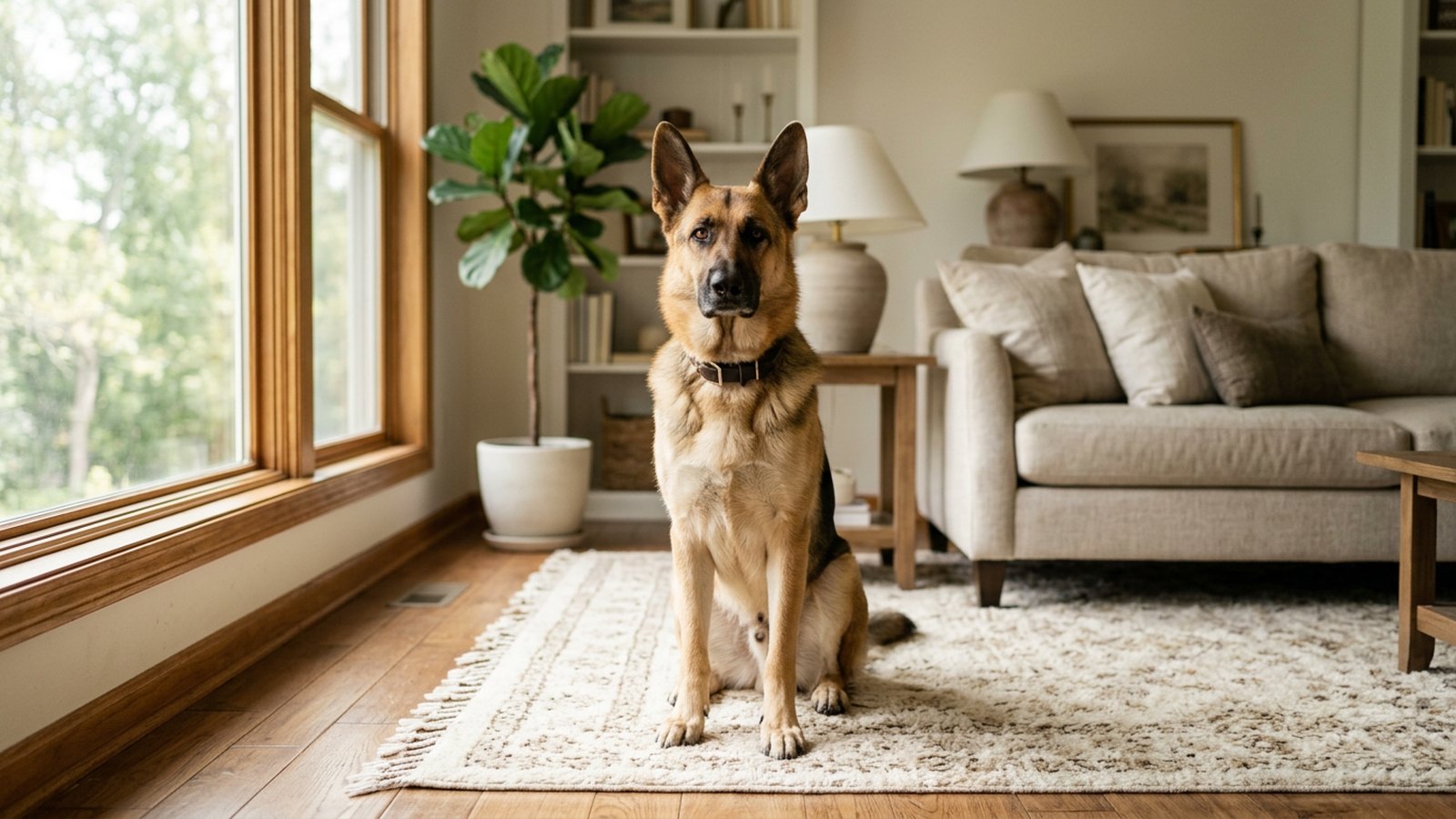
The kitchen sit and the park sit
You ask for a sit in your kitchen and you get it before the word is out of your mouth. You ask for the same sit at the park, with a spaniel loose on the grass and a crisp packet blowing past, and your dog looks straight through you. Nothing is broken. What you trained in the kitchen is, as far as your dog is concerned, a kitchen behaviour.
That gap feels personal, which is why owners reach for a louder voice or a firmer hand. It is not personal. The word "sit" was only one strand of a much bigger picture your dog actually learned: your kitchen, your body square to the counter, the treat tub on the worktop, the particular quiet of indoors. Change most of that picture and it no longer matches the one your dog has been paid for. The cue you thought you trained was never really the word on its own.
What stimulus control actually means
A cue is not a command. It is a signal that a behaviour is likely to pay off right now. Stimulus control is the technical name for the state where that signal, and only that signal, reliably produces that behaviour. The term comes out of operant conditioning and reached most dog owners through Karen Pryor's Don't Shoot the Dog! (Bantam, 1985), which is still the clearest short account of it.
The useful move is to stop asking "does my dog know sit?" and start asking "what is actually controlling this sit?" Very often the answer is the fridge door, your hand drifting towards your pocket, or the simple fact that you have stopped walking. Those are real cues, accurately learned. They are just not the ones you meant to teach, and none of them exist at the park.
Practical take: Test a cue with your hands in your pockets, standing somewhere new, with the food out of sight. Don't test it holding a treat at chest height and call the result proof.
Pryor's four conditions
Pryor puts it plainly on page 81 of Don't Shoot the Dog!. A behaviour is under stimulus control when all four of these are true:
- The behaviour always occurs on the cue. You give the signal, you get the behaviour. Not usually, not when the dog was already halfway there.
- The behaviour never occurs in the absence of the cue. No hopeful sits offered while you chat to a neighbour, in case something falls out of your pocket.
- The behaviour never occurs in response to a different cue. "Down" does not produce a sit. Neither does a raised eyebrow.
- No other behaviour occurs in response to this cue. "Sit" does not produce a spin, a paw, or a bark first and a sit second.
Read that list as a diagnostic, not a standard to feel bad about. Each condition that fails points somewhere different. Failing the first means the cue is weak or the context has changed too much. Failing the second means you have been paying the behaviour whenever it shows up, so the dog offers it speculatively. Failing the third means something other than your word is doing the work, usually your body. Failing the fourth means the cue was never cleanly attached to one behaviour.
Why most behaviours never reach it, and why that is fine
Here is the part most training articles skip: very few behaviours in an ordinary pet dog's life meet all four conditions. The ones that do usually belong to working dogs whose handlers drilled a few cues for months. Pryor treats stimulus control as an achievement rather than a baseline, and that framing is worth borrowing. A dog who sits every time at home, often in the garden and rarely at the park is not a failure. That dog is partway along a curve.
The evidence on how long the curve takes in a normal home is thin. Controlled training research measures outcomes, not the route. China, Mills and Cooper (Frontiers in Veterinary Science 7:508, 2020) ran 63 dogs in three matched groups and found dogs trained with reward-based methods returned on the first recall cue 82.5% of the time against 71.0% for dogs trained with electronic collars, and sat faster afterwards, 1.36 seconds against 1.67. That tells you which approach builds the more responsive cue. It tells you nothing about how many repetitions you need before your dog turns round at the park.
So choose. A recall you would bet on near a road deserves months of deliberate work. A trick sit for photographs does not. Spreading the same effort thinly across every cue you can think of is how people end up with a houseful of kitchen behaviours.
Building it: change one thing at a time
Pryor's Ten Laws of Shaping cover this directly. Law 2 says train one aspect at a time and never shape for two criteria at once. Law 4 says that when you introduce a new criterion, you relax the old ones. Law 1 says raise criteria in increments small enough that the dog always has a chance of being reinforced. Those three are the whole method for taking a cue outdoors, and the full set of laws is worth reading properly.
Three things change when you leave the kitchen. Move one of them and drop your standard on the other two.
- Location. Hallway, then garden, then a quiet pavement, then the park at a dull hour, then the park on a Saturday morning.
- Distance. Close enough to touch, then one step back, then a lead's length, then across a room.
- Distraction. A jogger across the field is a completely different exercise from a loose dog at close range. Treat them as different exercises.
Keep the sessions short. Pryor notes on page 65 that a learner's appetite for reinforcement falls off after roughly a dozen reinforcements, with an upper bound of something like eighty in a day. A handful of repetitions outdoors, then stop, beats a long drill. This sequencing is what Tavi's training module is built around, so you are working the next step rather than guessing at it.
When it falls apart, and it will the first time a squirrel commits, Law 9 applies: go back to kindergarten. Make the next repetition easy enough to succeed at, take the win, and stop. Repeating a cue louder at a dog who is already over threshold only teaches that the word can be ignored. The same thing happens on a pulling lead, where owners repeat a heel cue for a whole walk and wonder why it stops meaning anything.
Cleaning up the other three conditions
Condition one gets all the attention. The other three are what make a cue feel crisp rather than approximate, and they are usually quicker to fix.
For offered behaviours, stop paying them. If your dog sits at you speculatively and you feed it, you have taught a sit that runs without a cue, which is charming until you need the dog to keep walking. Look away, wait, ask, then pay. For the body-language problem, say the word with your hands still and your feet planted. If nothing happens, your hand was the cue all along, and you can fade it by shrinking the gesture a little at a time.
The fourth condition shows up as the behaviour salad: you say "sit" and the dog offers a down, a paw, a spin and finally a sit, working through its repertoire like a vending machine. That is a dog guessing, not disobeying: the cue was attached to a general mood of "do something" rather than one movement. Go back to a quiet room and pay only the one behaviour for a few short sessions.
Do not try to proof a cue by correcting the dog for missing it outdoors. A dog that fails at the park has not understood the cue in that picture, so a correction teaches only that the park is where unpleasant things happen. DK's Complete Dog Breed Book (2nd edn, 2020, p. 322) states that harsh handling "is simply not effective" and is "likely to cause more problem behaviours, including aggression and anxiety", and is equally blunt about choke chains used for disobedience: not effective.
It is not stubbornness, and it is not dominance
The dominance story survives because it explains the gap so neatly. The dog obeys at home and not at the park, therefore the dog is testing you, therefore you need to be firmer. Stimulus control explains the same gap without any of that, and better, because it also predicts which cues will fail and where.
The data points the same way. Hiby, Rooney and Bradshaw (Animal Welfare 13, 2004) asked 364 owners what they used and found 66% relied on vocal punishment, ahead of praise at 60% and food rewards at 51%, and that the more tasks an owner trained by punishment, the more problem behaviours they reported. That is correlational, so it cannot tell you which came first. The experimental work is sharper: Vieira de Castro and colleagues (PLOS ONE 15(12), 2020) followed 92 companion dogs from aversive, mixed and reward-based training schools, recorded mean lip-licking counts of 55.9 in the aversive group against 4.1 in the reward group, found elevated cortisol, and weeks later those same dogs read an ambiguous situation more pessimistically in a cognitive-bias test.
"Stubborn" describes your feelings in the moment, not your dog's plan. If a cue your dog genuinely knew has stopped working indoors, in a quiet room, with nothing else changed, that is a different question from stimulus control, and worth working through carefully. Sudden loss of a well-established response can also come from pain or failing hearing, both of which look exactly like disobedience. That is worth a vet check rather than more training.
Take one cue outdoors, one small step at a time
Tavi's training module orders skills by your dog's breed, age and how much training you have done before, so you know which step comes next. Every repetition is illustrated, and sessions run a few minutes, short enough to do before the park rather than instead of it. Free for your first pet.
Frequently asked questions
Why does my dog listen at home but not outside?
Because the behaviour is under the control of your home, not your cue. When you train in a kitchen, your dog learns the whole picture: the room, your posture, the food nearby, the quiet. Outdoors, almost none of that picture is present, so the cue looks unfamiliar and the competition for attention is far stronger. This is called stimulus control, and the fix is to retrain the cue in new places one variable at a time rather than repeating it louder in the place it is failing.
What is stimulus control in dog training?
Stimulus control is the state where a cue reliably produces one behaviour and nothing else does. Karen Pryor lists four conditions on page 81 of Don't Shoot the Dog!: the behaviour always occurs on the cue, it never occurs without the cue, it never occurs in response to a different cue, and no other behaviour occurs in response to that cue. Meeting all four is an achievement rather than a starting point, so treat the list as a diagnostic for which part of a cue needs work.
How long does it take before a cue works at the park?
There is no honest number for this, and anyone quoting one is guessing. It depends on the dog, the cue, how much the environment competes, and how systematically you raise difficulty. What is clearer is the direction of travel: work in short sessions, change only one of location, distance or distraction at a time, and drop your standards on the other two whenever you raise one. Expect weeks rather than days for a cue you want to hold up in a busy park.
Is my dog being stubborn or dominant when he ignores me outside?
Almost certainly not. A dog that responds at home and not at the park is showing you where the cue has been trained, not making a point about rank. Dominance-based explanations tend to lead owners towards harsher handling, and the evidence there is not encouraging. Vieira de Castro and colleagues (PLOS ONE, 2020) found substantially more stress signalling and elevated cortisol in dogs trained with aversive methods. Treat the gap as an unfinished cue and build it in easier places first.
Should I repeat the cue if my dog doesn't respond?
Try not to. Repeating a cue that is being ignored teaches your dog that the word can be ignored several times before anything happens, which weakens it further. Instead, treat the non-response as information: the situation was too hard. Move somewhere easier, shorten the distance, or wait for a lull in the distraction, then ask once. Pryor's ninth law of shaping covers this directly. When a behaviour falls apart, go back to kindergarten and rebuild from a step the dog can win.
Tavi's guides are informational and not a substitute for professional veterinary advice, diagnosis or treatment. When in doubt, call your veterinarian.
Sources
- Karen Pryor, Don't Shoot the Dog! (Bantam, 1985), pp. 54-59, 65, 81
- China, Mills & Cooper, Frontiers in Veterinary Science 7:508 (2020)
- Vieira de Castro et al., PLOS ONE 15(12) (2020)
- Hiby, Rooney & Bradshaw, Animal Welfare 13 (2004)
- DK, The Complete Dog Breed Book, 2nd edn (2020), p. 322